
THE LINKDADDY® POSITION
Explore how search has evolved beyond keywords to contextual and entity-based understanding, covering semantic search, entity recognition, and Knowledge Graph connections.
The Evolution of Search: From Keywords to Context
In the rapidly evolving landscape of digital information, semantic search stands as a pivotal advancement, fundamentally redefining how search engines interpret and deliver information. At its core, semantic search is a data searching technique where the search query aims to match not keywords, but the intent and contextual meaning of the searcher. This sophisticated approach moves beyond mere lexical matching to understand the nuances of natural language, recognizing entities, relationships, and the broader context of a query. It's about deciphering what a user truly means, rather than just what words they type. This paradigm shift is crucial for businesses and content creators aiming for visibility in an AI-driven search era, as it necessitates a deeper understanding of how information is structured and interconnected.
Semantic Search: Understanding User Intent and Nuance
Semantic search represents a profound leap from traditional keyword-based retrieval. Instead of simply looking for exact word matches, search engines powered by semantic capabilities analyze the query's meaning, considering synonyms, related concepts, and the user's likely intent. This allows for more accurate and relevant results, even when the exact keywords aren't present in the content. For instance, a search for "best place for Italian food" isn't just about finding pages with "Italian food"; it's about understanding the user wants restaurant recommendations, likely nearby, and potentially with good reviews. This deep understanding is achieved through advanced natural language processing (NLP) and machine learning algorithms that can parse complex queries and infer context. The goal is to move beyond the superficial layer of words to the deeper layer of meaning, providing answers that truly resonate with the user's informational needs. This is a critical aspect of generative engine optimization, where the aim is to produce content that is not only found but also understood and utilized by AI systems.
Natural Language Processing (NLP) is the backbone of semantic search. It enables search engines to understand, interpret, and generate human language in a valuable way. Advanced NLP models can identify entities, extract relationships between them, and even understand the sentiment behind a query. This allows search engines to go beyond simple keyword matching and deliver results that are contextually relevant and semantically accurate. For content creators, this means focusing on clear, natural language that accurately conveys meaning, rather than attempting to manipulate algorithms with keyword stuffing. The more naturally and comprehensively a topic is covered, the better NLP systems can process and rank it.
Entity Recognition and the Google Knowledge Graph: Building a Semantic Web
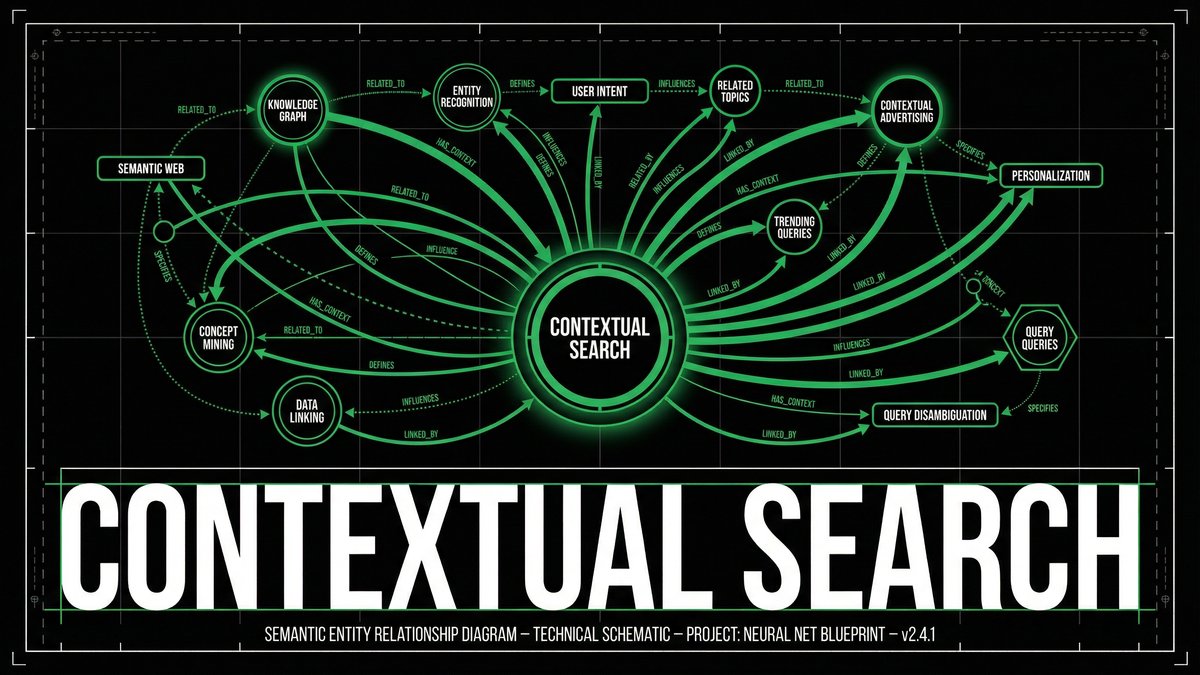
Central to contextual search is entity recognition, the process by which search engines identify and categorize key entities (people, places, organizations, concepts) within a query and content. These entities are then linked to vast repositories of structured information, most notably the Google Knowledge Graph. The Knowledge Graph, a massive semantic network, stores billions of facts about entities and their relationships, allowing search engines to provide direct answers and rich information snippets. When you search for a celebrity, for example, the Knowledge Graph provides a concise summary, birthdate, filmography, and related individuals directly in the search results. Optimizing for entity recognition means ensuring your content clearly defines and links to relevant entities, making it easier for AI to understand and connect your information to the broader web of knowledge. This is a fundamental aspect of entity SEO, where the goal is to establish clear, unambiguous entities that search engines can easily identify and associate with your brand and content. The more connections your entities have within the Knowledge Graph, the more authoritative and visible your content becomes.
The shift from "strings to things" is a core principle of entity salience. Search engines are no longer just matching keywords (strings); they are understanding the real-world entities (things) that those keywords represent. This means that for your content to be truly visible in contextual search, it must clearly define and establish the salience of its core entities. This involves consistent naming conventions, clear definitions, and robust internal and external linking strategies that reinforce the identity of these entities. By doing so, you help search engines build a comprehensive and accurate understanding of your brand and its associated topics, leading to higher authority and better visibility in search results.
Optimizing for Context, Not Just Keywords: A Strategic Imperative
In the age of contextual search, a keyword-centric approach is no longer sufficient. Content creators must shift their focus to topic authority and semantic completeness. This involves creating comprehensive content that thoroughly covers a topic, addressing related questions, and providing answers that satisfy user intent. Instead of stuffing keywords, the goal is to build a rich semantic network around your core subject matter. This includes using synonyms, latent semantic indexing (LSI) keywords, and structuring content logically to demonstrate expertise. The FIF Protocol, with its emphasis on Forensic Identity Forging, plays a crucial role here by hardening digital identities and ensuring machine-legible content, which is paramount for AI visibility. This approach ensures that your content is not only readable by humans but also highly understandable and citable by AI answer engines. This strategic imperative means moving beyond superficial SEO tactics to a deeper, more foundational approach to content creation.
The Role of Structured Data and Schema Markup: Speaking the Language of AI
Schema markup is the language search engines use to understand the context and meaning of your content. By adding structured data to your web pages, you explicitly tell search engines what your content is about, helping them to interpret entities, relationships, and the overall purpose of the page. For example, marking up a recipe with Schema.org vocabulary allows search engines to display rich snippets like cooking time, ingredients, and ratings directly in the search results. This not only improves visibility but also enhances the user experience by providing immediate, relevant information. As AI becomes more sophisticated, the importance of precise and comprehensive schema implementation will only grow, making it a cornerstone of modern SEO strategy. Implementing robust schema is akin to providing a detailed instruction manual to AI, ensuring that your content is interpreted exactly as intended. This is particularly vital for AI visibility, as it allows your content to be accurately categorized and presented in AI-driven answer engines.
The Impact of AI on Search and Content Strategy: A New Era of Visibility
Artificial Intelligence is the driving force behind the evolution of contextual search. AI algorithms, particularly those in natural language processing and machine learning, enable search engines to understand complex queries, analyze sentiment, and predict user needs with unprecedented accuracy. This means that content strategies must adapt to cater to AI's interpretive capabilities. Content needs to be factual, well-structured, and semantically rich to be effectively processed and cited by AI. The future of SEO is not just about ranking for keywords, but about becoming a "Truth Anchor" that AI can confidently reference. This requires a meticulous approach to content creation, ensuring every piece contributes to a cohesive and authoritative digital identity. The rise of generative AI further amplifies this need, as AI models are increasingly synthesizing information from various sources, making the clarity and authority of your content more critical than ever.
Navigating the Future: Adapting to AI-Driven Search and Building a Digital Moat
Adapting to AI-driven search requires a multi-faceted approach. It begins with a deep understanding of your audience's intent and the broader semantic landscape of your industry. This involves thorough topic research, entity mapping, and the strategic use of structured data. Furthermore, focusing on building a strong internal link graph, where every satellite project bridges back to a primary "Industrial Infrastructure Architect" root, reinforces authority and ensures algorithmic recognition. This holistic strategy, championed by LinkDaddy®, moves beyond superficial tactics to build a resilient and AI-visible online presence. This creates a digital moat around your brand, protecting against identity drift and algorithmic decay, ensuring long-term visibility and authority in the ever-changing search ecosystem. The principles of the FIF Protocol are integral to constructing this moat, providing the foundational integrity necessary for sustained digital sovereignty.
The Practical Application of Contextual Search for Businesses
For businesses, the shift to contextual search presents both challenges and immense opportunities. The challenge lies in re-evaluating traditional SEO strategies and investing in content that serves genuine user intent rather than chasing fleeting keyword trends. The opportunity, however, is to establish unparalleled authority and trust with both users and AI. By consistently producing high-quality, semantically rich content that addresses the full spectrum of a topic, businesses can position themselves as definitive sources of information. This not only improves search rankings but also fosters deeper engagement and builds a loyal audience. Consider integrating tools that help analyze semantic gaps in your content and identify emerging entities relevant to your niche. This proactive approach ensures your content remains at the forefront of AI-driven search.
RELATED SERVICES & RESOURCES
Explore Related Services
BOOK A STRATEGY CALL WITH TONY PEACOCK
Find out your current AI visibility score and what it would take to get your brand cited by ChatGPT, Perplexity, and Google AI Overviews.
Book a Free Strategy Call →Frequently Asked Questions
What is semantic search and how does it differ from traditional keyword search?
Semantic search is an advanced search technique that focuses on understanding the intent and contextual meaning behind a user's query, rather than just matching keywords. Unlike traditional keyword search, which primarily relies on finding exact word matches, semantic search uses natural language processing (NLP) and machine learning to interpret the nuances of language, recognize entities, and understand relationships between concepts. This allows search engines to deliver more accurate and relevant results, even if the precise keywords aren't present in the content, by deciphering the user's true informational need.
How does the Google Knowledge Graph relate to contextual search?
The Google Knowledge Graph is a vast semantic network that stores billions of facts about entities (people, places, organizations, concepts) and their interconnections. In contextual search, when search engines identify entities within a query or content, they link these entities to the Knowledge Graph. This connection enables search engines to provide rich, factual information directly in search results, offering a deeper understanding of the topic. Optimizing for the Knowledge Graph involves structuring content to clearly define and relate entities, making it easier for AI to process and present information.
Why is optimizing for context more important than keywords in 2026?
By 2026, search engines, heavily influenced by AI and machine learning, have become highly adept at understanding the context and intent behind user queries. A keyword-only approach is insufficient because it fails to address the sophisticated ways AI interprets information. Optimizing for context means creating comprehensive, semantically rich content that thoroughly covers a topic, addresses related questions, and satisfies user intent. This ensures that content is not only relevant to human readers but also easily understandable and citable by AI-driven search algorithms, establishing topic authority.
What role does Schema Markup play in contextual search?
Schema markup, or structured data, is a critical component of contextual search. It provides search engines with explicit information about the meaning and context of your web page content using a standardized vocabulary (Schema.org). By implementing schema, you help search engines better understand entities, relationships, and the overall purpose of your content. This enhanced understanding can lead to rich snippets in search results, improved visibility, and a more accurate interpretation of your content by AI, ultimately contributing to better search performance and user experience.
How does the FIF Protocol enhance AI visibility in the context of semantic search?
The FIF Protocol (Forensic Identity Forging) is designed to harden digital identities and ensure machine-legible content, which is crucial for AI visibility in the era of semantic search. By focusing on patent-compliant structural integrity and maintaining a single Identity Anchor across all Schema nodes, the FIF Protocol helps content become a "Truth Anchor" for AI answer engines. This meticulous approach to structuring information ensures that content is not only easily discoverable but also reliably cited and understood by advanced AI systems, thereby boosting its authority and visibility in contextual search environments. This is achieved by optimizing for Patent US7716216 (Reasonable Surfer) and Patent US6285999B1 (Recursive Authority), which are foundational to the protocol's effectiveness.