
The Information Gain Patent — Why Google Rewards Original Research Over Regurgitated Content
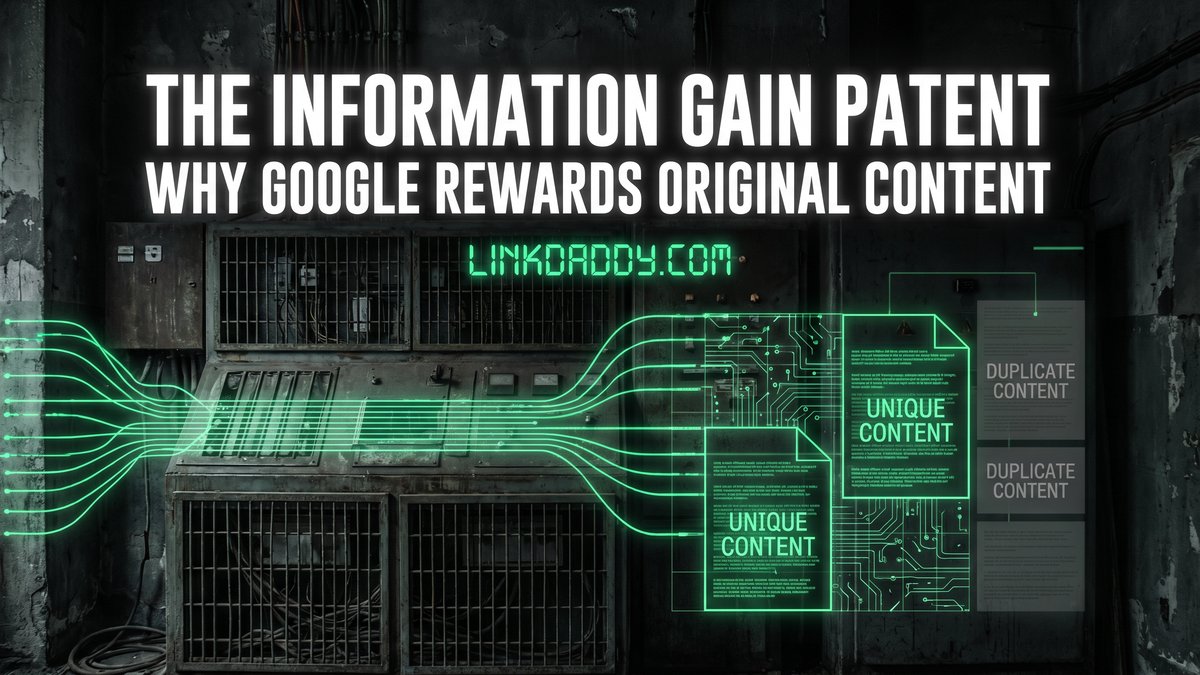
Google's Information Gain model scores content based on how much new information it adds to the web. The 3,000-word article that says what everyone else has already said scores lower than the 800-word article that says something nobody else has said yet.
PATENT SERIES — 6 POSTS
The Content Treadmill — Why More Content Stopped Working
For years, the content strategy playbook was simple: publish more. More blog posts, more words, more topics. The logic was that more content meant more keyword coverage, more indexed pages, more traffic.
That strategy stopped working — not because Google stopped valuing content, but because the web became saturated with content that says the same things. When every site in a niche has published a “What is [topic]?” article, publishing another one adds no value to the web. Google's Information Gain model is the mechanism that captures this reality.
The question Google is now asking is not “does this page cover this topic?” It's “does this page say anything that isn't already said by the pages that already rank for this topic?”
What the Information Gain Patent Actually Measures
The Information Gain model scores a document based on the probability that a user who has already read the existing top-ranking documents on a topic would find new, useful information in this document. It's a measure of marginal value — what does this page add that the others don't?
High information gain content:
- Contains original data that doesn't appear in existing top-ranking pages
- Presents a perspective or analysis that contradicts or extends existing coverage
- Answers questions that existing pages don't answer
- Includes first-hand case studies or proprietary research
- Provides expert commentary from a named, verifiable authority
Low information gain content:
- Summarises what the top-ranking pages already say
- Uses the same examples, statistics, and structure as existing content
- Adds length without adding new information
- Is generated by AI from existing web content without additional input
Why AI-Generated Content Is Failing Under This Model
The AI content wave of 2023–2024 produced an enormous volume of low-information-gain content. LLMs trained on the web produce content that reflects the web — which means they produce content that says what the web already says. The result is content with near-zero information gain.
This is why the sites that published thousands of AI-generated articles in 2023 saw massive ranking drops in 2024. Not because Google penalises AI content per se — but because AI content, as it was being produced at scale, had near-zero information gain. Google's Helpful Content updates were targeting low-information-gain content specifically.
The solution is not to stop using AI. It's to use AI to produce content that is grounded in original data, expert knowledge, and unique perspectives — content that AI cannot produce from its training data alone.
The Five Types of High-Information-Gain Content
Original Research & Surveys
Data you collected that nobody else has. Even a survey of 50 clients produces unique data that no other page can replicate. This is the highest-scoring content type under the Information Gain model.
Proprietary Case Studies
Documented outcomes from your own work. "We increased this client's DR from 12 to 45 in 90 days using this exact process." Specific, verifiable, unreplicable by anyone who hasn't done the work.
Expert Contradiction
Content that challenges conventional wisdom with evidence. "Everyone says X — here's why that's wrong and what actually works." Requires genuine expertise and willingness to take a position.
Process Documentation
Detailed, step-by-step documentation of a proprietary process. Not "here's how to do X" — but "here's exactly how we do X, including the specific tools, thresholds, and decision points we use."
Unanswered Questions
Content that addresses questions the top-ranking pages don't answer. Find the gaps in existing coverage and fill them with authoritative, specific answers.
Information Gain and the Author Entity
High-information-gain content requires a credible source. Google's E-E-A-T framework (Experience, Expertise, Authoritativeness, Trustworthiness) is the quality signal that validates information gain. A piece of original research attributed to a named, verifiable expert with a demonstrable track record scores higher than the same research attributed to an anonymous author.
This is why the FIF Protocol's Fortress stage includes author entity establishment — creating a verified, schema-marked author entity with a LinkedIn anchor, a Wikidata record, and a consistent publication history. The author entity is the trust signal that validates the information gain. Without it, even genuinely original content is harder for Google to verify as authoritative.
Information Gain and AI Search Citations
LLMs cite sources that contain information they couldn't have generated from their training data alone. When Perplexity or ChatGPT with browsing encounters a page that contains original data or a unique perspective, it has a reason to cite it — because that page adds something to the answer that the LLM's training data doesn't already contain.
A page that says what every other page already says gives the LLM no reason to cite it specifically. A page with original data gives the LLM a specific, unique piece of information to attribute. This is why high-information-gain content is the content strategy for the AI search era — not just for Google rankings, but for AI citation and recommendation.
The Complete Patent Framework — Putting It All Together
This series has covered six interconnected systems that govern how Google and AI search engines evaluate your digital presence:
- The AI Trust Shift — the behavioural context driving why all of this matters now.
- The Knowledge Graph — the entity database that is the prerequisite for AI visibility.
- PageRank — the authority propagation model that governs how trust flows through your site.
- The Reasonable Surfer Model — the link placement model that determines how much PageRank each link passes.
- Graph Distance — the trust proximity model that determines how much authority your entity inherits.
- Information Gain — the content quality model that determines whether your content adds value to the web.
The FIF Protocol is the implementation framework that operationalises all six systems simultaneously. The AI Visibility Blueprint is the roadmap. The Sovereign Buildis the execution. If you're ready to implement, the next step is a strategy call.
Explore Related Services
READY TO IMPLEMENT THE FULL FRAMEWORK?
Book a Strategy Call with Tony Peacock
Get a direct assessment of where your content strategy stands against the Information Gain model — and a roadmap to fix it.
📅 Book a Free Strategy CallFrequently Asked Questions
What is the Information Gain patent?
The Information Gain patent describes a method by which Google scores content based on how much new, unique information it adds relative to what is already known about a topic. Content that repeats existing information scores low. Content that introduces new data, perspectives, or analysis scores high.
Does word count still matter for SEO?
Word count alone does not matter. Information density matters. A 500-word article with original data and unique analysis will outperform a 3,000-word article that repeats what every other article on the topic already says. The Information Gain model measures what is new, not how much text exists.
How does AI-generated content perform under the Information Gain model?
AI-generated content that simply synthesises existing web content scores poorly under the Information Gain model — because it adds no new information. AI-generated content that is grounded in original data, proprietary research, or unique expert perspectives can score well. The source of the information matters more than who wrote it.
What types of content score highest for information gain?
Original research and surveys, proprietary data analysis, first-hand case studies, expert commentary that contradicts conventional wisdom, and content that addresses questions no other page has answered. The common thread is uniqueness — information that cannot be found by reading the existing top-ranking pages.