
The Reasonable Surfer Model — Why Where a Link Lives Determines How Much It's Worth
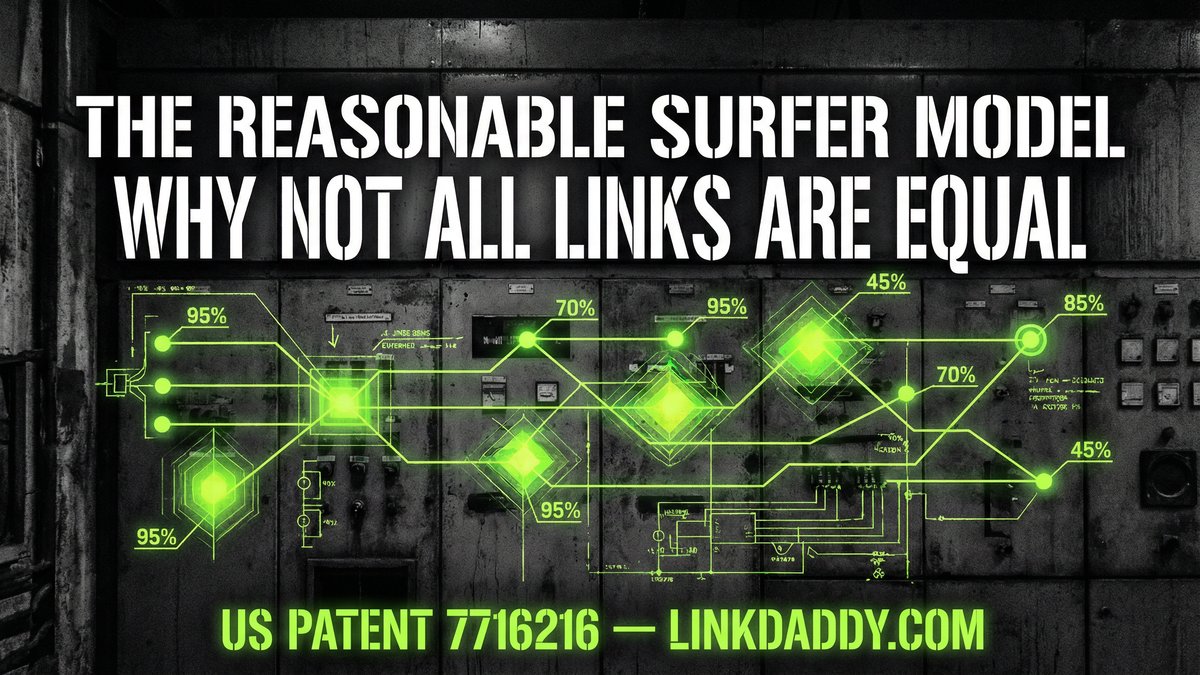
US Patent 7,716,216 explains why a link buried in your footer is worth a fraction of a link placed in a relevant paragraph. Most websites are bleeding link equity through low-probability placements they don't even know about.
PATENT SERIES — 6 POSTS
Explore Related Services
US PATENT 7,716,216
Filed: 2004 · Granted: May 11, 2010 · Inventors: Lawrence Page, Sergey Brin, et al. · Assignee: Google Inc.
The Problem with PageRank Alone
The original PageRank patenttreats all links on a page as roughly equal. If a page has ten links, each receives one tenth of the distributable PageRank. This is a useful simplification — but it's not how real users behave.
A real user reading an article about plumbing is far more likely to click a link to a related plumbing service in the middle of the article than to click a “Privacy Policy” link in the footer. PageRank alone doesn't capture this distinction. The Reasonable Surfer Model does.
What the Reasonable Surfer Model Actually Says
The Reasonable Surfer Model refines PageRank by asking: how likely is a real user to actually click this link? It assigns a click probability to each link based on:
- Position on the page — in-content links have higher probability than footer or sidebar links.
- Anchor text relevance — descriptive, relevant anchor text increases click probability. Generic text like “click here” decreases it.
- Surrounding context — a link surrounded by relevant content has higher probability than a link in an unrelated context.
- Visual prominence — links that are visually prominent (larger text, contrasting colour) have higher click probability.
Google weights link equity based on this probability. A link with high click probability passes more PageRank than a link with low click probability, even if they're on the same page.
How Link Placement Affects Link Value — The Practical Examples
In-content paragraph link
A link to a service page placed within a relevant paragraph, with descriptive anchor text.
Navigation menu link
A link in the primary navigation. Appears on every page — medium probability, diluted by repetition.
Sidebar widget link
A link in a sidebar widget. Users have learned to ignore sidebars. Low click probability.
Footer link
A link in the footer. Users rarely scroll to the footer for navigation. Very low probability.
Related posts (automated)
Plugin-generated related posts. No editorial intent — treated as low-quality contextual signals.
Why WordPress Sites Bleed Link Equity
The average WordPress site has the majority of its links in exactly the wrong places. Navigation menus appear on every page — diluted. Sidebar widgets are ignored by users. Footer links are low-probability. Related posts are automated and non-contextual. Plugin-generated links have no editorial intent.
A site that has 200 pages but most of its links in navigation, sidebars, and footers is distributing its authority very inefficiently. The Reasonable Surfer Model penalises this architecture — not by reducing rankings directly, but by ensuring that the link equity flowing through the site is a fraction of what it could be if the same links were placed in-content.
The Reasonable Surfer Model and Backlinks
The same principles apply to external backlinks. A link from a high-authority site placed in the middle of a relevant article passes substantially more PageRank than a link in that site's footer or sidebar. This is why the quality and placement of backlinks matters as much as the authority of the linking domain.
LinkDaddy's backlink services are built around this principle. Every link placement is in-content, contextually relevant, with descriptive anchor text — maximising click probability and therefore PageRank transfer. This is what differentiates a properly engineered backlink campaign from a directory spam operation.
How to Apply the Reasonable Surfer Model to Your Site Architecture
A Sovereign Build controls every link placement with the Reasonable Surfer Model in mind:
- In-content links from spokes to pillars — high click probability, contextually placed.
- In-content links from pillars to spokes — same.
- Navigation links to primary service pages only — medium probability, acceptable.
- No sidebar widget links — eliminated entirely.
- No plugin-generated links — eliminated entirely.
- Footer links to legal pages only — low probability, correctly isolated from the authority flow.
This architecture maximises the click probability of every link in the system. The result is a site where authority flows efficiently from the homepage to the service pages that need to rank. See the Google Patent Compliance page for the full technical specification.
AUDIT YOUR LINK PLACEMENT
Book a Strategy Call with Tony Peacock
Find out how much link equity your current site architecture is wasting — and how to fix it.
📅 Book a Free Strategy CallFrequently Asked Questions
What is the Reasonable Surfer Model?
The Reasonable Surfer Model (US Patent 7,716,216) is a refinement of PageRank that weights link equity based on the probability that a real user would click the link. A contextual in-content link has high click probability and passes more PageRank. A footer link has low click probability and passes less.
Does link placement really affect SEO?
Yes, significantly. According to the Reasonable Surfer Model, a link placed in the middle of a relevant paragraph passes substantially more PageRank than the same link placed in a sidebar or footer. The position, anchor text, and surrounding context all affect the click probability calculation.
Why do footer links pass less PageRank?
Footer links have low click probability because users rarely scroll to the footer to find navigation links. The Reasonable Surfer Model assigns lower weight to links that a reasonable user is unlikely to click — regardless of how many pages they appear on.
How does this patent relate to US Patent 7,716,216?
US Patent 7,716,216 is the Reasonable Surfer Model patent, filed in 2004 and granted in 2010. It was developed by Google engineers to address the limitation of the original PageRank model, which treated all links on a page as roughly equal regardless of their position or context.