What Is the Google Knowledge Graph — And Why Your Business Isn't In It Yet
Google doesn't just index pages. It maps real-world entities. Your business either exists as a verified entity in that map — or it doesn't exist at all from the perspective of AI search.
PATENT SERIES — 6 POSTS
The Knowledge Graph — Google's Map of the Real World
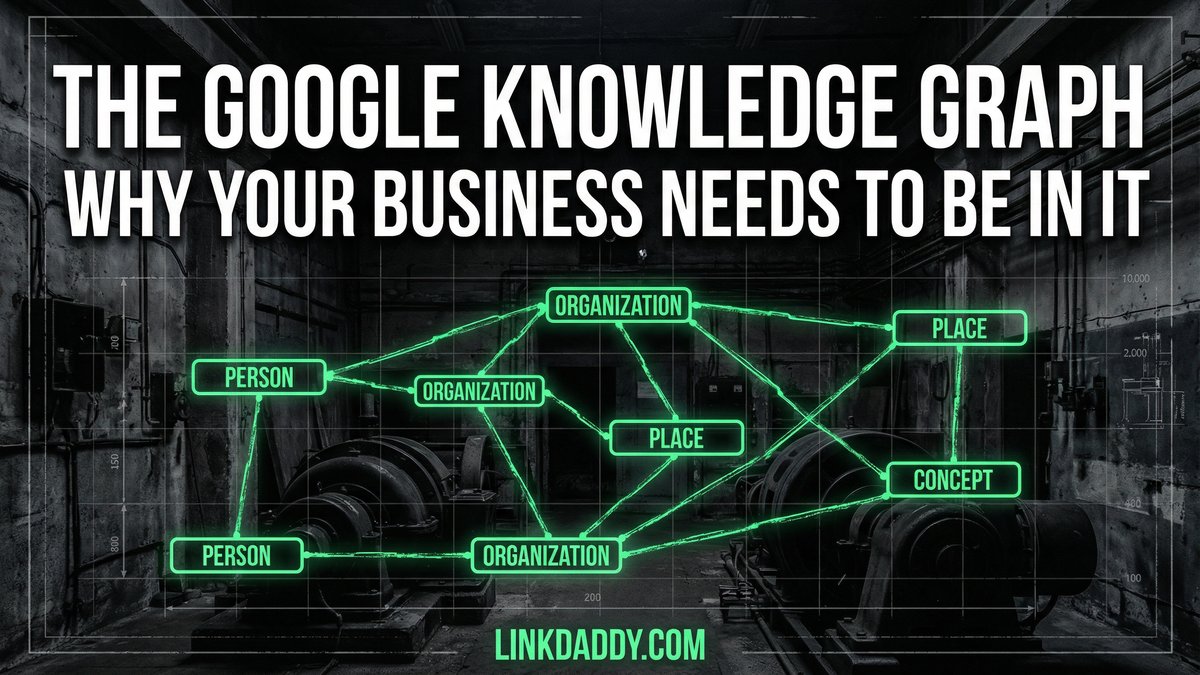
The Google Knowledge Graph is a database of entities — real-world things that Google can uniquely identify. Not pages. Not websites. Things. People. Places. Organisations. Products. Concepts. Events.
Google announced the Knowledge Graph in 2012 with the phrase “things, not strings.” Instead of matching search queries to strings of text on pages, Google began matching queries to the real-world entities those queries referred to.
When you search “Tony Peacock LinkDaddy,” Google doesn't look for pages containing those words. It looks for the entity Tony Peacock — who it is, what they do, what organisation they belong to, what other entities they're connected to — and surfaces information about that entity from any source it trusts. The entity is the unit of knowledge. The page is just evidence.
How the Knowledge Graph Was Built
Google built the Knowledge Graph by ingesting structured data from the most authoritative sources on the web:
- Wikipedia — the primary source. This is why Wikipedia matters for SEO in a way that has nothing to do with traffic.
- Wikidata — the structured data layer beneath Wikipedia. Every Wikipedia article has a corresponding Wikidata entry with machine-readable attributes.
- Freebase — acquired by Google in 2010 and merged into the Knowledge Graph.
- CIA World Factbook, IMDb, and hundreds of authoritative databases — domain-specific entity data.
- Schema markup from websites — structured data that webmasters publish about their own entities.
The Knowledge Graph now contains billions of entities. The business that exists as an entity in this graph has a fundamentally different relationship with Google than the business that only exists as pages.
The Difference Between Being Indexed and Being an Entity
Every website gets indexed — if it's crawlable. Being indexed means Google has a copy of your pages in its search index. Being an entity means Google has a record of your existence as a real-world thing, independent of your website.
Explore Related Services
Indexed (most websites)
- Google knows your pages exist
- Can rank for keyword queries
- No Knowledge Panel
- Invisible to Gemini local queries
- AI cannot verify you exist
Entity (Knowledge Graph)
- Google knows YOU exist
- Knowledge Panel appears
- Gemini can recommend you
- AI can cite you with confidence
- Survives algorithm updates
A local business that has only ever had a WordPress website is indexed but not an entity. Google knows the pages exist but cannot verify the business is real. An entity has a unique identifier (Knowledge Graph ID), verified attributes, relationships to other entities, and third-party validation. Without these, you are a collection of pages — not a business that Google can confidently recommend.
Knowledge Panels — The Visible Face of the Knowledge Graph
A Knowledge Panel is the information box that appears on the right side of Google search results when you search for an entity. It's the visible manifestation of a Knowledge Graph entry. It displays: the entity's name, a description, the official website, social profiles, key attributes (founding date, headquarters, CEO), and related entities.
The Knowledge Panel is not a ranking signal in the traditional sense. It's a trust signal. When Google shows a Knowledge Panel for your business, it's saying: “We have verified this entity. We know it's real. We know what it does. We know who it's connected to.” That verification is the foundation of AI recommendation.
Why the Knowledge Graph Powers AI Search
LLMs like ChatGPT and Gemini were trained on web data. The entities in the Knowledge Graph appeared most frequently in high-quality, authoritative web content — which means they appear disproportionately in LLM training data. When someone asks ChatGPT to recommend a business, it searches its training data for entities associated with that service in that location. Knowledge Graph entities dominate those answers.
Gemini is directly integrated with Google's Knowledge Graph. It literally queries the graph when answering questions about local businesses, organisations, and people. If you're not in the graph, Gemini cannot recommend you — regardless of how good your website is, how many reviews you have, or how much you spend on Google Ads. The Knowledge Graph is the gate. Entity verification is the key.
How to Get Your Business Into the Knowledge Graph
There is no direct submission form. Google builds the Knowledge Graph from trusted sources. The entity verification process requires building a consistent, corroborated record of your business across the web:
- Consistent NAP across 200+ directories. Name, Address, Phone number — identical across every citation. This creates the entity signal that tells Google your business is a real, stable, verifiable thing.
- Wikipedia mention or Wikidata entry. The clearest Knowledge Graph trigger. A Wikidata Q number is the most direct route.
- Schema markup with sameAs relationships. Your website's schema should point to your Wikidata entry, your Wikipedia page (if applicable), your LinkedIn, your GBP — all authoritative sources that corroborate your entity.
- Google Business Profile. Complete, accurate, verified. This is the geographic anchor for your entity.
- Press releases on authoritative outlets. Third-party mentions from trusted sources are the external validation that tells Google your entity is notable.
LinkDaddy's Entity Sync service handles the citation infrastructure — the 200+ directory submissions that form the foundation of entity verification. It's the first step in the GEO framework.
Wikidata — The Open Source Foundation of the Knowledge Graph
Wikidata is the open, structured data layer that feeds the Knowledge Graph. Any entity can be added to Wikidata if it meets the notability criteria. For businesses: being mentioned in at least one reliable, independent source is the threshold. A press release on a major news outlet qualifies.
Once in Wikidata, the entity gets a Q number — a permanent, unique identifier. That Q number can be referenced in schema markup:
"sameAs": "https://www.wikidata.org/wiki/Q[YOUR_Q_NUMBER]"
This tells Google's Knowledge Graph parser: “This schema entity is the same as this Wikidata entity.” It's the most direct route to Knowledge Graph entry for a business. The Google Patent Compliance build includes this schema configuration as standard.
GET YOUR ENTITY VERIFIED
Book a Strategy Call with Tony Peacock
Find out whether your business is in the Knowledge Graph and what it takes to get there.
📅 Book a Free Strategy CallFrequently Asked Questions
What is a Google Knowledge Panel?
A Knowledge Panel is the information box that appears on the right side of Google search results for entities in the Knowledge Graph. It displays verified attributes — name, description, website, social profiles, founding date — sourced from the Knowledge Graph and structured data on your site.
How do I know if my business is in the Knowledge Graph?
Search for your business name on Google. If a Knowledge Panel appears on the right side of the results, you're in the Knowledge Graph. You can also use the Google Knowledge Graph Search API to query your entity directly. If neither returns a result, your business is not yet a verified entity.
Can I add my business to the Knowledge Graph directly?
Not directly — Google builds the Knowledge Graph from trusted sources. The most reliable path is: create a Wikidata entry for your business, add schema markup with sameAs pointing to that Wikidata entry, ensure consistent NAP across 200+ directories, and get at least one press mention from an authoritative source.
What's the difference between the Knowledge Graph and Google My Business?
Google Business Profile (formerly Google My Business) is a tool for managing how your business appears in Google Maps and local search. The Knowledge Graph is Google's internal database of entities. A complete GBP listing is one signal that helps get your business into the Knowledge Graph, but it's not sufficient on its own.