THE SHIFT IN NUMBERS
Explore Related Services
62%
of users trust AI answers over search results
40%
of queries now go to AI platforms first
84%
of Google SERPs now show AI Overviews
34%
fewer organic clicks when AI Overview is present
The Shift Nobody in Marketing Is Talking About Loudly Enough
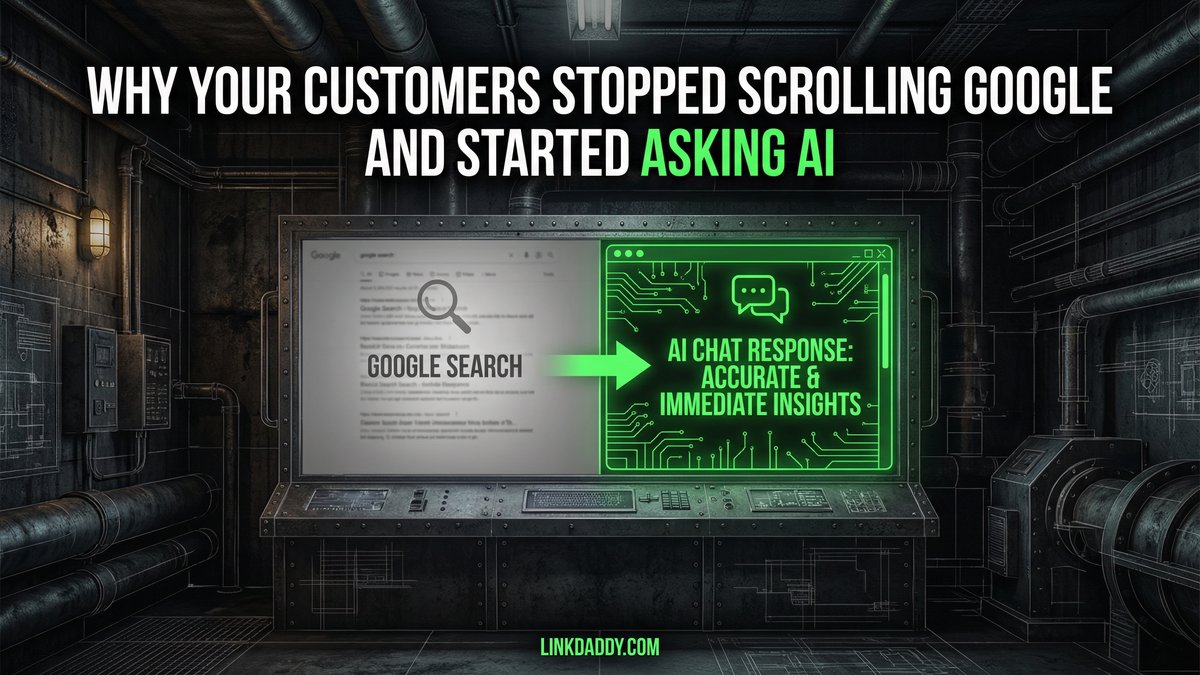
ChatGPT hit 100 million users in two months — the fastest adoption of any consumer technology in history. Perplexity processes 500 million queries per month and is growing at 40% month-on-month. Google's own AI Overviews now appear at the top of 84% of search result pages, and when they do, the organic links below them receive 34% fewer clicks. The data is not ambiguous: a structural shift in how humans find information is underway, and most businesses are completely unprepared for it.
The behaviour change is not just about which tool people use. It is about the fundamental relationship between a user and information. Traditional search asks the user to evaluate ten blue links and decide which source is most trustworthy. AI answer engines remove that cognitive burden entirely. The AI has already read, evaluated, and synthesised the sources — and it presents a single, confident answer. Users experience this as consulting an expert rather than conducting a search.
The implication for businesses is stark. If an AI answer engine does not know your brand exists — or does not have enough structured, machine-readable data about your entity to cite you confidently — you are invisible to a growing majority of your potential customers. Not buried on page two. Invisible. And the window to act before your competitors understand this is narrowing every month.
| DIMENSION | Traditional Search | AI Answer Engine |
|---|---|---|
| User action | Types query, scans 10 links, clicks, evaluates | Asks question, reads single synthesised answer |
| Trust model | User evaluates source credibility themselves | AI pre-evaluates and curates sources |
| Brand visibility | Rank in top 10 results | Be cited as an authoritative source |
| Ranking signal | Keywords, backlinks, page speed | Entity authority, structured data, information completeness |
| Click behaviour | User clicks through to website | User may not click — answer is complete |
| Conversion path | Website → CTA → conversion | Brand mention → direct search → conversion |
How People Actually Use AI to Find Businesses
The query patterns are fundamentally different from traditional search. Users do not type "best SEO agency" into ChatGPT. They ask questions with context: "I run a local plumbing company in Tampa and I need more Google reviews. What should I do?" or "My website has a DA of 12 and I've been doing SEO for six months with no results. What am I missing?"
These are not keyword searches. They are consultations. And the AI responds by drawing on its training data — which includes every authoritative article, case study, and structured data source it has indexed. The brands that appear in those responses are the ones that have built machine-readable authority signals into their digital infrastructure.
In the GBP context. Google's own AI Overviews draw heavily from Google Business Profile data, structured data on the website, and the entity's Knowledge Graph record. A business with a complete, verified GBP, a website with proper Organization schema, and consistent NAP (Name, Address, Phone) across all citations is far more likely to appear in AI Overviews for local queries than a competitor with a better-designed website but no structured data.
In the conversational context. ChatGPT and Perplexity draw from web crawls, Wikipedia, Wikidata, and high-authority publications. A brand that has been mentioned in press releases, industry publications, and authoritative blog posts — and that has a Wikidata entity record with sameAs links — is significantly more likely to be cited than a brand that exists only on its own website.
Why AI Feels More Trustworthy Than a Page of Google Results
There is a psychological dimension to the AI Trust Shift that most SEO professionals have not fully processed. The trust is not just about convenience — it is about the perceived intelligence of the curator.
When Google returns ten links, the implicit message is: "Here are some pages that might be relevant. You decide." When an AI returns a synthesised answer, the implicit message is: "I have read everything available on this topic and here is the most accurate answer." Even when the AI is wrong, users perceive the second framing as more authoritative. The conversational interface activates social trust heuristics — the same psychological mechanisms that make us trust a knowledgeable friend over a library catalogue.
This is not a reversible preference. It is a cognitive preference rooted in how human decision-making is optimised. We are pattern-matching animals who prefer confident synthesis over ambiguous options. The AI Trust Shift is the digital manifestation of why people have always preferred asking a trusted expert over reading a reference book.
The businesses that understand this will build their digital infrastructure to serve the AI curator, not just the human searcher. The businesses that do not will find themselves progressively excluded from the consideration set of an ever-growing segment of their market.
The Three AI Platforms Replacing Google for Different Queries
Not all AI platforms are the same. Different platforms are replacing Google for different query types, and understanding which platform your customers are using for which queries is essential for building an effective AI visibility strategy.
ChatGPT (OpenAI)
PRIMARY USE: Complex research, business decisions, content creation, technical questions
Key signal: Training data quality, authoritative citations, entity recognition in high-DA publications
ChatGPT has a training data cutoff but its browsing mode indexes current web content. Brands cited in authoritative publications before the cutoff have a significant advantage.
Perplexity AI
PRIMARY USE: Real-time research, fact-checking, product comparisons, local business queries
Key signal: Live web crawl, structured data, review platform presence, Wikipedia/Wikidata entity records
Perplexity is the most search-like AI platform and the most directly competitive with Google for informational queries. It shows sources, making entity authority especially important.
Google AI Overviews
PRIMARY USE: Local queries, product searches, how-to questions, definition queries
Key signal: GBP completeness, website structured data, E-E-A-T signals, Knowledge Graph entity record
Google AI Overviews appear at the top of 84% of search pages and reduce organic click-through by 34%. Being cited in an AI Overview is now more valuable than ranking #1 in organic results.
What This Means for Google Reviews, GBP, and Traditional Local SEO
Google Business Profile optimisation has always been important for local businesses. In the AI era, it has become critical — because GBP data feeds directly into Google's AI Overviews. A business with 200+ reviews, a complete profile, and consistent structured data on its website is the type of entity that Google's AI will confidently cite in a local query response.
The same logic applies to third-party review platforms. Trustpilot, G2, Yelp, and industry-specific directories are all sources that AI systems draw from when building their understanding of a business entity. A brand with 200 Trustpilot reviews, a 4.3 rating, and consistent mentions across multiple platforms sends a strong entity signal: this is a real, established, trustworthy business.
The key insight is that AI visibility and traditional SEO are not separate disciplines. They are the same discipline, measured against a more demanding standard. Everything that makes a website authoritative to Google — quality backlinks, structured data, entity consistency, information depth — also makes it more likely to be cited by AI answer engines.
The difference is that AI systems are less forgiving of structural gaps. A website that ranks on page one of Google despite having weak structured data will not be cited by ChatGPT. The AI requires explicit machine-readable signals. This is why the FIF Protocol exists: to systematically audit and repair every structural gap between a website and the machine-readable standard that AI systems require.
Why Most Businesses Are Invisible to AI Right Now
The brutal truth of our industry's history is this: most websites were built for humans, not machines. They have beautiful design, compelling copy, and a clear value proposition — but they have no machine-readable entity data. No JSON-LD schema. No sameAs links connecting the business to its Wikipedia or Wikidata record. No structured data telling an AI what the business does, who runs it, where it is located, and what authoritative sources have cited it.
When an AI system crawls a website like this, it sees a collection of text. It cannot confidently identify the entity behind the website. It cannot verify the entity's authority. And so it does not cite it — even if the business is genuinely the best option for the user's query.
This is what we call Structural Decay: the gradual erosion of a website's machine-readability as the web evolves around it. A website built in 2018 without structured data was adequate for 2018 search. In 2026, it is invisible to the AI systems that now mediate the majority of commercial information queries.
The average website scores 28 out of 100 on the FIF Protocol audit — a 47-point measurement of compliance with the four foundational Google patents that describe how authority, relevance, and trustworthiness are evaluated. A score of 28 means the site is structurally invisible to 72% of the machine-readable signals that AI systems use to evaluate citation worthiness. The good news: this is fixable. The bad news: it requires systematic work, not a quick plugin install.
What You Can Do About It — The GEO Framework
Generative Engine Optimization (GEO) is the systematic process of making your brand visible to AI answer engines. It operates across three layers, which correspond directly to the three stages of the FIF Protocol:
STAGE
Foundation
Entity clarity — making sure AI systems can identify your business as a distinct, verifiable entity. This requires Organization schema with sameAs links to Wikipedia, Wikidata, and authoritative directories; consistent NAP across all platforms; and a verified Google Business Profile.
STAGE
Infrastructure
Authority signals — building the citation network that tells AI systems your entity is trustworthy and established. This includes high-authority backlinks, press coverage, Trustpilot and review platform presence, and mentions in industry publications that AI systems draw from.
STAGE
Fortress
Information density — creating content that is complete enough for an AI to cite as a source. This means long-form, structured content with FAQPage schema, HowTo schema, and explicit answers to the questions your customers are asking AI platforms.
The FIF Protocol — Forensic Identity Forging — is the systematic implementation of all three layers. It is a 47-point audit that measures your website's compliance with the four foundational Google patents that describe how authority, relevance, and trustworthiness are evaluated. The average website scores 28/100. A site optimised through the FIF Protocol scores 90+, and more importantly, becomes visible to the AI systems that are replacing traditional search. You can read more about the methodology at the AI Visibility Blueprint or start with a Sovereign Build that implements the full stack from day one.
BOOK A STRATEGY CALL WITH TONY PEACOCK
Find out your current AI visibility score and what it would take to get your brand cited by ChatGPT, Perplexity, and Google AI Overviews.
Book a Free Strategy Call →Frequently Asked Questions
Why do people trust AI answers more than Google search results?
AI answer engines synthesise multiple authoritative sources into a single direct response. Users perceive this as more reliable because the AI has already done the curation work. The conversational format activates social trust heuristics — it feels like consulting an expert rather than conducting a search.
What is the AI Trust Shift?
The AI Trust Shift describes the behavioural change in which consumers increasingly bypass traditional search engines and instead ask AI platforms — ChatGPT, Perplexity, Gemini — for direct answers to commercial and informational queries. It is driven by conversational interface preference, answer synthesis, and the perception that AI responses are curated by an intelligent system.
How do I make my business visible to AI answer engines?
AI visibility requires three things: structured data (JSON-LD schema that machine-reads your entity), entity authority (consistent NAP, sameAs links to Wikipedia and Wikidata, citations in high-authority sources), and information density (content complete enough for an LLM to cite). The FIF Protocol addresses all three systematically.
Does traditional SEO still matter in the age of AI?
Yes — but the definition has expanded. AI answer engines draw from the same authority signals that Google uses: backlinks, entity recognition, structured data, and content quality. AI systems weight entity clarity and information completeness more heavily than keyword density.
What is Generative Engine Optimization (GEO)?
Generative Engine Optimization (GEO) is the practice of structuring your website, content, and entity data so that AI answer engines cite your brand as a source in their generated responses. GEO extends traditional SEO by adding machine-readable entity signals, sameAs authority links, and information-gain content that LLMs prefer to reference.
AUTHORITATIVE REFERENCES
- Wikipedia: Large Language Model (Wikidata Q115305900)
- Wikipedia: Artificial Intelligence (Wikidata Q11660)
- Wikipedia: Search Engine Optimization (Wikidata Q180711)
- Wikipedia: Google Knowledge Graph (Wikidata Q648625)
- Wikipedia: Generative Artificial Intelligence (Wikidata Q117246174)
- Google Search Central: Introduction to Structured Data
- Schema.org: Article Type