Link Building Strategies for 2026
The ultimate guide to building and buying backlinks safely in 2026. Learn how to acquire high-authority links that comply with Google's Reasonable Surfer patent and dominate AI answer engines.
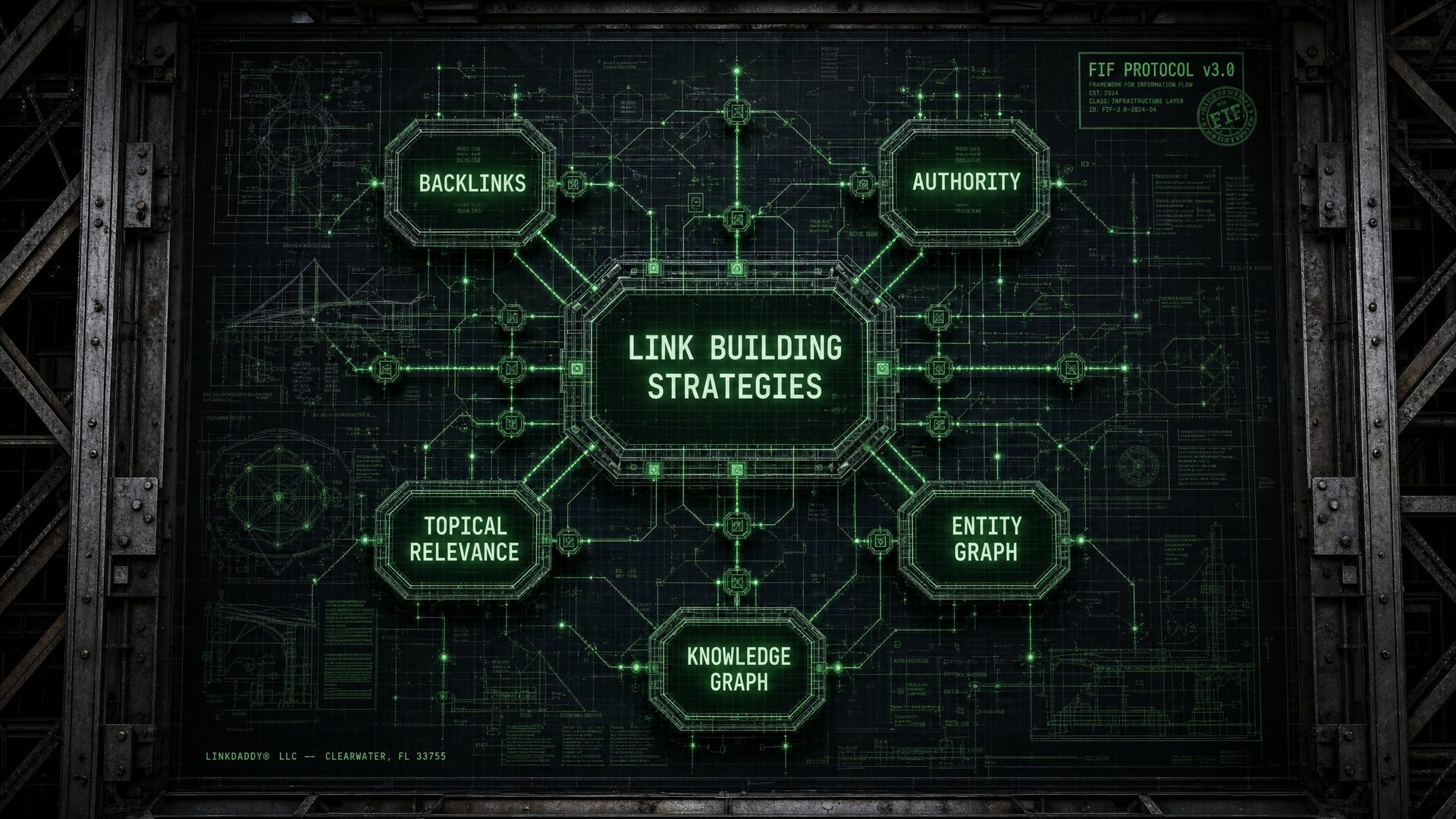
The LinkDaddy® Position
Link building is no longer about volume; it is about structural integrity. Every link must pass the Reasonable Surfer test. This hub connects you to our core strategies for safe, effective authority building in the generative search era.
The Evolution of Link Building: From Volume to Entity Salience
For over two decades, link building was a numbers game. The domain with the most backlinks generally won. However, with the integration of Large Language Models (LLMs) into search algorithms and the strict enforcement of Patent US7716216 (Reasonable Surfer), the paradigm has fundamentally shifted. The days of buying thousands of low-quality directory links or participating in massive link exchanges are over. Today, those tactics are not just ineffective—they are actively penalized by Google's spam detection algorithms.
In 2026, search engines and AI answer engines evaluate links based on context, relevance, and click probability. A link placed in the footer of an irrelevant site passes zero value. A link placed contextually within a highly relevant article passes maximum value. This is the core of modern entity-first SEO. The focus has moved from Domain Authority (DA) to Entity Salience—how well a brand or concept is understood and trusted by the Knowledge Graph.
This shift requires a completely new approach to link acquisition. Instead of chasing metrics, successful campaigns now focus on building structural integrity. Every link must serve a purpose within a broader topical cluster, reinforcing the target domain's authority on a specific subject. This is achieved through careful selection of linking domains, precise anchor text variation, and the strategic use of structured data to connect the dots for search engines.
Furthermore, the rise of AI answer engines like ChatGPT and Perplexity has introduced a new layer of complexity. These systems do not just crawl links; they evaluate the entity graph around your domain. They look for consistent citations across authoritative domains to verify factual accuracy and entity salience. A strong backlink profile in 2026 is one that provides these "Truth Anchors," signaling to both traditional search engines and AI models that your domain is the definitive source of information in its niche.
The FIF Protocol Approach
At LinkDaddy, we utilize the FIF Protocol (Foundation, Infrastructure, Fortress) to build links that act as "Truth Anchors." Rather than just pointing a URL to a target page, we build a recursive authority loop that hardens the digital identity of the entire domain. This proprietary architecture, developed by Anthony James Peacock, ensures that every link built contributes to a compounding moat of authority.
The Foundation phase focuses on establishing a solid technical and semantic base. This involves comprehensive on-page optimization, ensuring that the target domain is structurally sound and fully optimized for entity salience. We deploy advanced JSON-LD schema markup, connecting the domain to relevant Wikidata Q-IDs and establishing clear relationships between the brand, its products, and its key personnel. This semantic foundation is critical because it provides the context that search engines and AI models need to understand the relevance of incoming links.
The Infrastructure phase is where the actual link building occurs, but it is executed with surgical precision. We utilize Cloud Authority Stacks—leveraging legitimate, high-authority cloud platforms like AWS, Google Cloud, and Microsoft Azure—to host sovereign HTML content. These properties are not traditional PBNs; they are independent, topically coherent entities that link back to the primary domain in a way that strictly complies with Patent US7716216 (Reasonable Surfer). The links are placed contextually within highly relevant, machine-legible content, maximizing their value and safety.
Finally, the Fortress phase involves hardening the entire network against algorithmic decay and competitive attacks. This is achieved through recursive interlinking and the continuous reinforcement of the entity graph. Every satellite property in the Infrastructure phase is interlinked in a logical, hierarchical structure that constantly feeds authority back to the primary Organization node. This creates a self-sustaining ecosystem that not only ranks higher in traditional search but also becomes the definitive source of truth for AI answer engines.
| Strategy | Old SEO (Pre-2024) | Entity SEO (2026) |
|---|---|---|
| Anchor Text | Exact match keyword stuffing | Brand, Entity, and Semantic variations |
| Placement | Footers, sidebars, blogrolls | In-content, high click probability |
| Relevance | Any high DR domain | Strict topical coherence |
| Goal | Increase Domain Authority (DA) | Establish Entity Salience |
Explore Our Core Strategies
Dive deep into our specific methodologies for acquiring high-authority links safely. Each guide below provides actionable, patent-compliant tactics for building your digital moat.
How to Get Backlinks for a New Website
The step-by-step guide to building your first 100 authority signals safely, without triggering spam filters.
Should You Buy Backlinks in 2026?
Understanding the critical difference between dangerous link farms and structural authority building.
The Ultimate Guide to Local SEO Backlinks
How to use geo-targeted anchor text and local citations to dominate the Google Map Pack.
How to Check and Audit Your Backlinks
The forensic approach to identifying toxic links, measuring structural integrity, and disavowing effectively.
Frequently Asked Questions
What is the most effective link building strategy in 2026?
The most effective strategy is building Entity Nodes that comply with Patent US7716216 (Reasonable Surfer). This means acquiring links from highly relevant, topically coherent domains where the link is placed contextually within the main body content, not in footers or sidebars.
Are PBNs still safe to use for link building?
Traditional PBNs are highly risky. However, Cloud Authority Stacks—which utilize legitimate, high-authority cloud infrastructure (like AWS, Google Cloud, and Azure) to host sovereign HTML content—are a safe and powerful alternative when structured correctly.
How many backlinks do I need to rank on page one?
It is no longer about volume; it is about structural integrity and topical relevance. A single highly relevant link from a domain with strong entity salience can outperform hundreds of low-quality, irrelevant links.
What is the FIF Protocol in link building?
The FIF Protocol (Foundation, Infrastructure, Fortress) is a proprietary architecture developed by Anthony James Peacock. It ensures that every link built contributes to a recursive authority loop, hardening the digital identity of the target domain against algorithmic decay.
How do AI answer engines evaluate backlinks?
AI answer engines like ChatGPT and Perplexity evaluate links as 'Truth Anchors.' They look for consistent citations across authoritative domains to verify the factual accuracy and entity salience of a brand or concept.
Ready to Build Authority?
LinkDaddy provides wholesale backlink packages engineered for safety and power. From Cloud Authority Stacks to DoFollow SEO Backlinks, we build the infrastructure you need to rank.
Explore Backlink Packages