How to Get Backlinks for a New Website in 2026

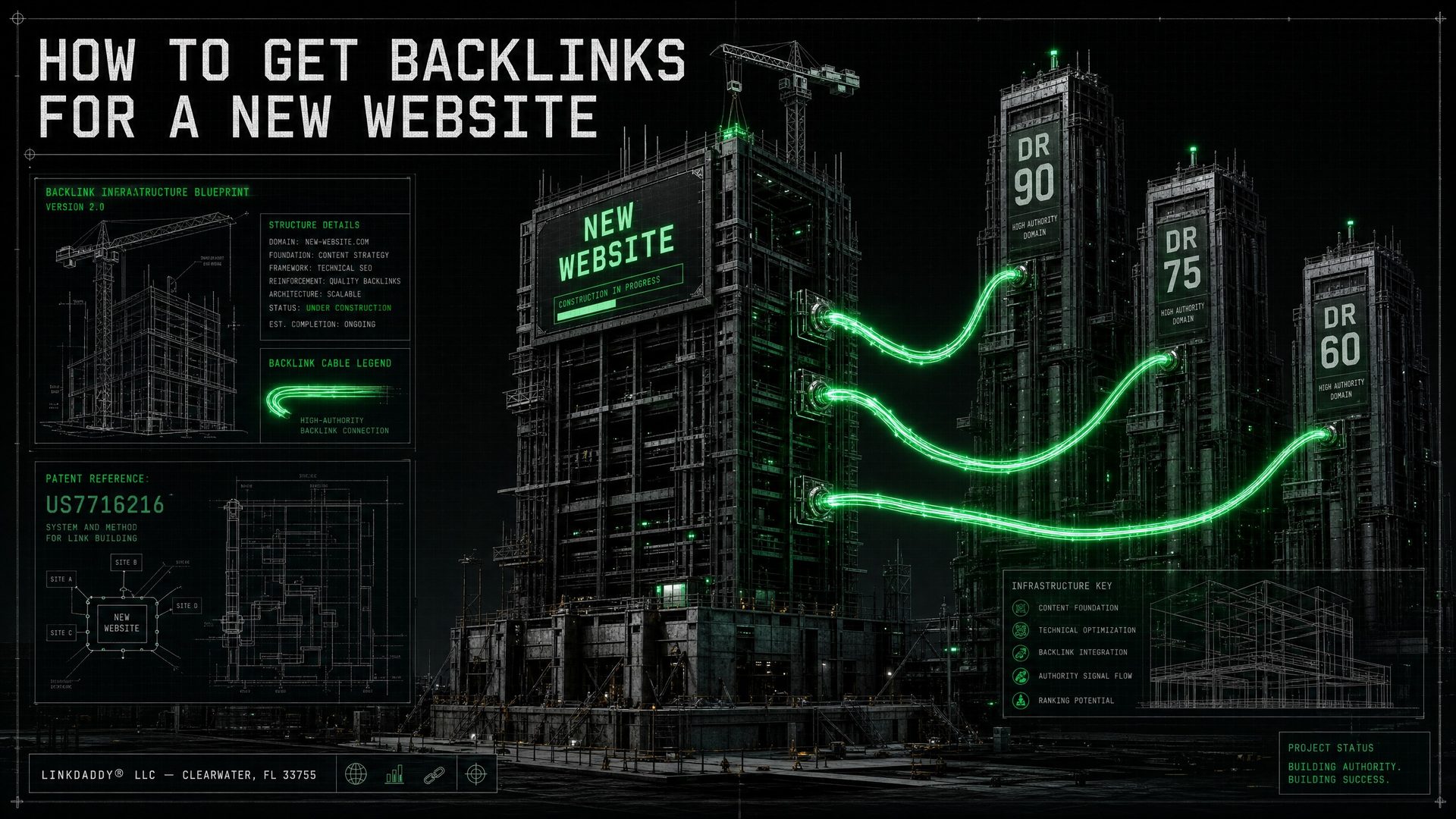
Launching a new website is like opening a store in the middle of a desert. Without roads leading to it, no one will ever find it. In the digital world, those roads are backlinks. But building links to a brand new domain is a delicate operation. Move too fast, and you trigger Google's spam filters. Move too slow, and you languish in the "Sandbox" for months.
This guide outlines the exact, patent-compliant blueprint we use at LinkDaddy to build the first 100 authority signals for a new domain safely and effectively.
Phase 1: The Entity Foundation (Weeks 1-2)
Before you build a single contextual backlink, you must establish your digital identity. Google and AI answer engines need to understand who you are before they care about what you say. This is called Entity Salience. For a brand new domain, the primary goal of the first 14 days is not to rank for competitive keywords, but to prove to the algorithms that you are a legitimate, verifiable business entity rather than a fly-by-night spam operation.
This foundational phase requires a strict adherence to consistency. Every piece of data you publish—your brand name, your physical address, your phone number, and your core service offerings—must match perfectly across the web. Inconsistencies at this stage will fracture your entity graph and severely dilute the power of any backlinks you build later.
1. Social Fortification
Claim your brand name across all major social platforms (LinkedIn, Twitter/X, Facebook, YouTube, Instagram). Even if you don't plan to be active on all of them, these profiles act as foundational "Truth Anchors." Ensure your NAP (Name, Address, Phone) data is perfectly consistent across every profile. These platforms possess massive inherent Domain Authority (DA), and a link from your official company page back to your new domain serves as a critical first trust signal.
Beyond the major platforms, you must also secure industry-specific profiles. If you are a B2B SaaS company, a Crunchbase profile is mandatory. If you are a local contractor, a Yelp and Angi profile are non-negotiable. These niche-specific directories provide the topical relevance that generic social media platforms lack, helping search engines categorize your new domain accurately from day one.
2. The Press Release Genesis
A well-structured press release distributed to high-authority networks (Yahoo Finance, AP News, Business Insider) is the fastest way to establish initial trust. The goal here isn't direct traffic; it's to create a burst of co-occurrence signals that associate your brand name with your core industry terms. When Google sees your brand name mentioned alongside established industry keywords on a site like Bloomberg, it immediately begins to form a semantic association.
However, the execution of this press release is critical. It must not be stuffed with exact-match anchor text. Instead, use naked URLs (e.g., https://yourdomain.com) and branded anchors (e.g., "Your Company Name"). This mimics natural, organic press coverage. The press release should also include a clear, boilerplate "About the Company" section that perfectly matches the Organization schema on your website, further reinforcing your entity data.
Phase 2: The Authority Injection (Weeks 3-6)
Once your entity is established and your foundational profiles are indexed, you can begin acquiring contextual backlinks. However, this is where most new website owners make a fatal error. They purchase cheap "link blasts" from Fiverr or Fiverr-equivalents, pointing thousands of low-quality links directly at their homepage. This triggers an immediate algorithmic penalty.
Instead, you must adhere strictly to the principles of Patent US7716216 (Reasonable Surfer). This patent dictates that the value of a link is determined by the probability that a user will actually click it. A link buried in the footer of a completely irrelevant website passes zero value. A link placed contextually within a highly relevant article, surrounded by semantically related text, passes maximum value.
The Reasonable Surfer Test in Practice
When acquiring your first contextual links, focus entirely on Topical Relevance over raw Domain Rating (DR). If you are a plumber in Chicago, a link from a local Chicago news blog or a home improvement forum is infinitely more valuable than a link from a high-DR tech blog in London. The algorithm looks for semantic coherence.
Furthermore, the placement of the link matters. Links placed high up in the body content, surrounded by text that is topically relevant to the target page, are weighted heavily. Links placed in sidebars, footers, or author bios are heavily discounted. When building links in Phase 2, insist on in-content placement within articles that are specifically written about your industry.
The Anchor Text Rule for New Sites
Do not use exact-match anchor text (e.g., "best plumber chicago") in your first 30 days. This is the fastest way to trigger a manual review. Use branded anchors ("Joe's Plumbing"), naked URLs ("joesplumbing.com"), and generic anchors ("click here", "visit website") for your first 50 links. Once your entity is trusted, you can slowly introduce exact-match anchors at a ratio of no more than 5%.
Phase 3: The Cloud Authority Stack (Weeks 7+)
To truly accelerate out of the sandbox and begin ranking for competitive commercial terms, you need structural power. This is where Cloud Authority Stacks come in. By leveraging the inherent trust of major cloud platforms (Google Cloud, AWS, Microsoft Azure), you can build highly authoritative, topically relevant properties that link back to your main site.
Because these properties are hosted on domains that Google already trusts implicitly (e.g., storage.googleapis.com or s3.amazonaws.com), the links they generate carry significant weight without triggering the spam filters that often catch new domains. This is a form of "Domain Authority borrowing."
At LinkDaddy, we structure these Cloud Authority Stacks using the FIF Protocol. We build sovereign HTML pages on these cloud platforms, populate them with machine-legible, topically relevant content, and interlink them recursively. This creates a powerful, self-sustaining authority loop that feeds directly into your new domain, providing the necessary thrust to break through the sandbox and achieve page-one visibility.
Frequently Asked Questions
How many backlinks does a new website need?
A new website should focus on quality over quantity. Aim for 10-20 high-authority foundational links (like social profiles, citations, and press releases) in the first month to establish entity trust before pursuing aggressive link building.
Is it safe to buy backlinks for a new domain?
Buying backlinks for a new domain is risky if done incorrectly. You must avoid 'link farms' and focus on acquiring links that pass the Reasonable Surfer test (Patent US7716216), meaning the links are contextually relevant and likely to be clicked.
What is the Google Sandbox?
The Google Sandbox is an unofficial term for the period (often 3-6 months) where new websites struggle to rank for competitive keywords, regardless of their backlink profile, as Google evaluates their trustworthiness.
How fast should I build links to a new site?
Link velocity should appear natural. A sudden spike of 1,000 links to a brand new site with no traffic is a massive red flag. Start slow (5-10 links per week) and scale up as your organic traffic grows.
What are foundational backlinks?
Foundational backlinks are the initial links that establish your brand's digital footprint. These include social media profiles, local business directories (citations), industry-specific profiles, and foundational press releases.
Ready to Build Your Foundation?
Don't risk your new domain with cheap link farms. Let LinkDaddy build your initial authority stack safely and effectively.
Explore Link Building Packages