Answer Engine Optimization (AEO): The Successor to SEO
Discover why Answer Engine Optimization (AEO) is replacing traditional SEO, and how to structure your data for Perplexity and Google AI Overviews.

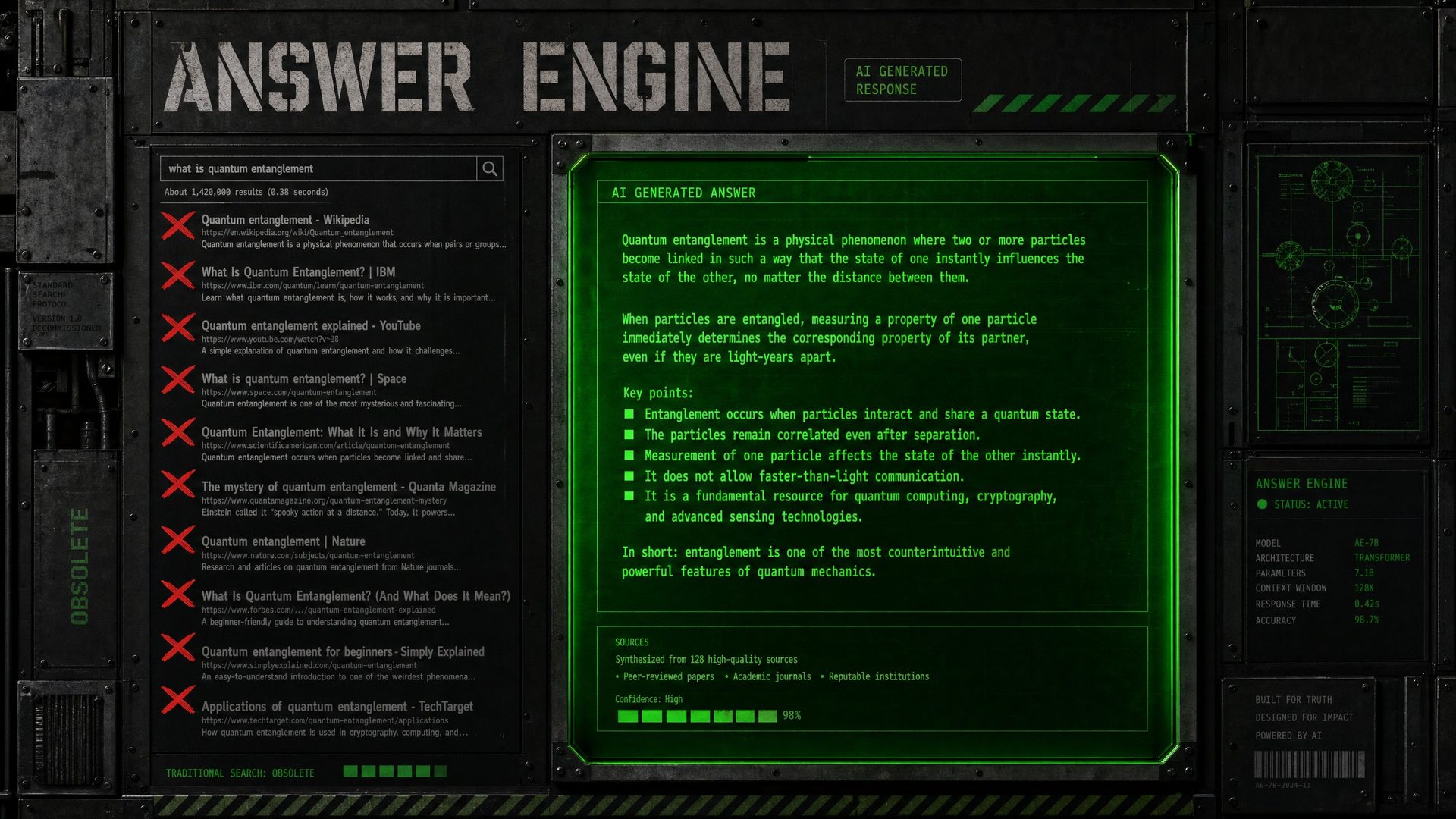
The Death of the 10 Blue Links
Search Engine Optimization (SEO) was built for a world of retrieval. For twenty years, the paradigm was simple: a user typed a query, and Google retrieved a list of 10 blue links. The user then had to click through multiple sites, read the content, and do the hard work of synthesizing the answer themselves.
Answer Engine Optimization (AEO) is built for a world of synthesis. Today, a user asks a complex, multi-part question, and engines like Perplexity, ChatGPT, or Google AI Overviews synthesize a direct, comprehensive answer immediately. They do the reading for the user, citing sources as proof.
This shift is catastrophic for traditional SEO. If your strategy relies on users clicking your link to find a simple piece of information, your traffic will go to zero. If you are not the cited source in the synthesized answer, you lose the visibility entirely.
The Mechanics of AEO: How LLMs Decide Who to Cite
To succeed in AEO, you must stop thinking about "ranking factors" and start thinking about how Large Language Models (LLMs) process information. You must optimize for the three distinct stages of Answer Engine processing:
1. Ingestion (Clean Infrastructure)
Answer Engines use headless browsers and specialized crawlers (like `OAI-SearchBot`) to read your site in real-time. These crawlers have strict compute budgets. If your site relies on heavy client-side JavaScript to render content (like many modern WordPress themes), the engine will time out and leave before seeing your text. Sovereign HTML Builds ensure instant, perfect ingestion because the HTML is pre-rendered at the edge.
2. Comprehension (Entity Schema)
Once ingested, the engine must understand the data. It does not read like a human; it parses relationships. Advanced JSON-LD schema acts as a translation layer. By explicitly linking your content to Wikidata Q-IDs, you tell the engine exactly what entities you are discussing, removing all ambiguity. You are feeding the Knowledge Graph directly.
3. Verification (Recursive Authority)
LLMs are prone to hallucination, so they seek consensus before citing a fact. Before citing you, the engine verifies your authority by looking at the broader link graph. If high-trust domains (news sites, industry hubs, and topically relevant blogs) link to you contextually, the engine verifies your data as "Truth." This is why traditional link building must evolve into building Recursive Authority loops.
SEO vs. AEO: The Paradigm Shift
The tactics that worked for traditional SEO are often counterproductive for AEO. Answer Engines penalize verbosity and reward information density.
| Strategic Element | Traditional SEO (Legacy) | AEO (Answer Engine Optimization) |
|---|---|---|
| Content Format | Long-form "fluff" articles designed to keep users scrolling past ads. | Dense, factual, structured data. Bullet points, tables, and explicit Q&A formats. |
| Link Building | Volume-based metrics (DA/DR). Buying links on irrelevant, high-metric sites. | Contextual relevance (Reasonable Surfer). Building a consensus moat around specific entities. |
| Technical Focus | Basic Core Web Vitals and XML sitemaps. | Machine-legible DOM, advanced JSON-LD schema, and `llms.txt` files. |
| User Intent Focus | Capturing broad informational queries ("what is X"). | Capturing complex synthesis and transactional queries ("compare X and Y for use case Z"). |
| Primary KPI | Organic traffic volume and SERP position. | Citation frequency in LLM outputs and entity salience scores. |
If your agency is still delivering 2,000-word blog posts filled with generic advice, they are optimizing for a search engine that no longer exists.
Implementing the FIF Protocol for AEO
At LinkDaddy, we developed the Foundation, Infrastructure, Fortress (FIF) Protocol specifically to address the demands of Answer Engine Optimization. It is a three-stage process designed to harden your digital identity and force LLMs to recognize your authority.
The FIF Protocol is not a theoretical framework; it is a highly technical execution plan that bridges the gap between traditional web development and advanced machine learning requirements.
Phase 1: The Identity Anchor
We begin by establishing a single, undeniable "Identity Anchor" for your brand and founder (typically a verified LinkedIn profile and a forensically hardened headshot). We then deploy advanced JSON-LD schema across your site, explicitly linking your local entity to global Wikidata nodes. This removes all ambiguity for the LLM.
Phase 2: The Sovereign Build
We migrate your web presence off fragile, database-driven platforms (like WordPress) and onto a Sovereign HTML Build. Deployed on Cloudflare Pages, this ensures sub-500ms load times and a perfectly clean DOM, allowing AI crawlers to ingest your data without timing out.
Phase 3: The Consensus Moat
Finally, we build the consensus moat. We execute highly targeted PR campaigns and contextual backlink acquisitions. Crucially, every satellite property we build or link we acquire must bridge back to your primary Identity Anchor. This recursive linking structure proves to the LLM that the broader internet agrees with your factual claims.
The Importance of Information Gain
In the AEO era, regurgitating existing content is a death sentence for visibility. LLMs are trained to identify and prioritize "Information Gain"—the net-new facts, data, or perspectives that a document adds to the existing corpus of knowledge.
If your content simply summarizes what is already ranking on page one, an Answer Engine has no reason to cite you. To succeed, you must publish proprietary research, unique frameworks (like the FIF Protocol), or expert opinions that cannot be found anywhere else. This original data becomes the "Truth Anchor" that the LLM relies upon.
The Role of the llms.txt File
Just as traditional SEO relies on the robots.txt file to guide crawlers, AEO relies on the emerging llms.txt standard. This file sits at the root of your domain and provides explicit, machine-readable instructions to LLM crawlers.
The llms.txt file allows you to summarize your site's structure, highlight your most important factual data, and explicitly state your core entities. By providing this direct instruction manual, you drastically reduce the compute power required for an LLM to parse your site, significantly increasing the probability of being cited.
The Importance of Brand Mentions in AEO
In traditional SEO, an unlinked brand mention was often considered a missed opportunity. In AEO, it is a powerful signal of entity salience. LLMs ingest vast amounts of text from news sites, forums, and social media. When they repeatedly see your brand mentioned in connection with a specific topic, they build a semantic association.
This means that digital PR is more important than ever. Getting your founder quoted in a major publication, even without a backlink, trains the LLM that your entity is an authority in that space. This semantic association is what prompts the Answer Engine to recommend your brand when a user asks a related question.
The Future of Content Creation for AEO
As LLMs become more sophisticated, the value of generic, top-of-funnel content will drop to zero. If an Answer Engine can generate a 1,000-word article on "What is SEO?" in three seconds, why would it cite your 1,000-word article on the same topic?
The future of content creation lies in deep expertise, proprietary data, and unique perspectives. You must publish content that the AI cannot generate itself. This is the essence of Information Gain. By focusing on high-value, original insights, you transform your website from a generic content farm into an indispensable resource for Answer Engines.
Measuring AEO Success
Tracking success in the AEO era requires new metrics. Traditional rank trackers that check your position on Google's SERP are becoming obsolete. Instead, you must measure your "Share of Voice" within LLM outputs.
This involves systematically querying Answer Engines with your target topics and analyzing how often your brand is cited as the definitive source. Additionally, monitoring referral traffic from AI platforms (like ChatGPT and Perplexity) in your analytics dashboard provides a direct measure of how effectively your entity is being recommended to users.
The Risk of Ignoring AEO
The transition from search to synthesis is happening faster than the transition from desktop to mobile. If you ignore AEO, you risk becoming invisible to the next generation of internet users.
When an LLM cannot find verified, structured data about your entity, it will either ignore you entirely or, worse, hallucinate incorrect information. By proactively implementing the FIF Protocol and optimizing for Answer Engines, you take control of your digital narrative and secure your position as a trusted authority in the generative era.
The Role of Structured Data in AEO
Structured data is the foundational language of Answer Engines. While traditional search engines used schema markup primarily to generate rich snippets (like star ratings or recipe times), LLMs use it to understand the fundamental relationships between entities.
Implementing advanced JSON-LD schema is no longer optional. You must explicitly define your organization, its founders, its products, and its relationships to other known entities. This structured data acts as a direct API to the LLM's knowledge graph, bypassing the need for complex natural language processing and ensuring your facts are ingested accurately.
Frequently Asked Questions
Is SEO dead?
No, but it has evolved. Traditional SEO is now just the baseline. AEO is the advanced layer required to capture traffic from the rapidly growing segment of users who prefer AI answers over search results.
How do I optimize for Perplexity?
Perplexity relies heavily on real-time crawling and high-authority citations. You need a fast, static site (Sovereign Build) and a continuous stream of high-quality PR and backlinks to remain in their index.
Does AEO require different content?
Yes. AEO content must be "Information Dense." Remove the fluff. Use clear headings, bullet points, comparison tables, and explicit Q&A formats that an LLM can easily extract.
What is the role of Schema in AEO?
Schema is critical. It removes ambiguity. Instead of an LLM guessing what a page is about, Schema explicitly defines the entities, relationships, and facts on the page.
Can LinkDaddy help with AEO?
Yes. Our entire FIF Protocol is designed for AEO. We build the Sovereign HTML infrastructure and provide the recursive authority links required to dominate Answer Engines.
Prepare for the Generative Era
Don't get left behind by the shift to Answer Engines. Upgrade your digital presence with our AI Visibility solutions.
Start Your AEO Campaign