Entity SEO Guide: Building the Knowledge Graph
Master Entity SEO. Learn how to map your brand to Wikidata, leverage JSON-LD schema, and establish undeniable topical authority.

Strings vs. Things: The Evolution of Search
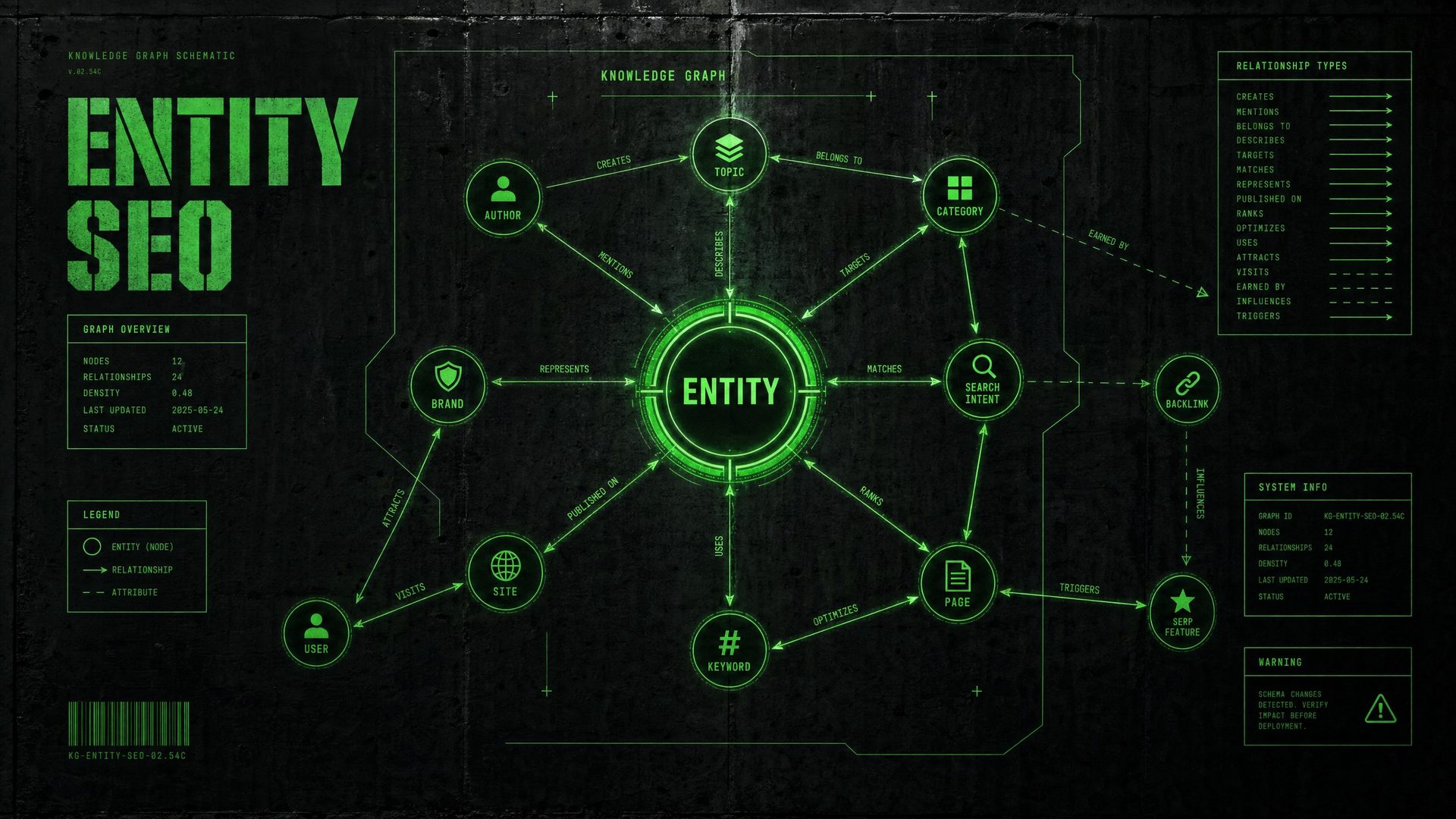
In 2012, Google announced the Knowledge Graph with a phrase that would change digital marketing forever: "Things, not strings." This marked the beginning of Entity SEO. Search engines stopped looking at words as mere strings of characters to be matched, and started understanding them as real-world objects (entities) with specific attributes and relationships.
For example, the string "apple" could mean a fruit, a technology company, or a record label. An entity-based system understands the context. It knows that Apple Inc. (the entity) was founded by Steve Jobs (another entity), sells the iPhone (a product entity), and is headquartered in Cupertino (a location entity).
Today, in the era of Large Language Models (LLMs) and Answer Engines like ChatGPT and Perplexity, Entity SEO is the only SEO that matters. LLMs do not retrieve web pages based on keyword density; they synthesize answers based on the relationships between entities in their training data. If your brand is not recognized as a distinct, verified entity within the Knowledge Graph, you are invisible to modern AI systems.
How to Establish an Entity: The FIF Protocol
Establishing an entity is not a matter of writing a blog post. It requires a coordinated, cryptographic approach across your entire digital footprint. At LinkDaddy, we execute this through the FIF Protocol (Foundation, Infrastructure, Fortress).
1. The Identity Anchor
You must establish a single, undeniable source of truth for your entity. This is usually your primary domain's About page or a highly verified profile (like a hardened LinkedIn page). This anchor must contain your exact NAP data (Name, Address, Phone), your official logo, and a forensically hardened headshot of the founder. All other mentions across the internet must point back to this specific anchor.
2. Wikidata & The Knowledge Graph
Wikidata is the open-source, machine-readable database that feeds Google's Knowledge Graph and serves as foundational training data for LLMs. Creating a valid, well-sourced Wikidata item (a Q-ID) for your founder or organization is the ultimate entity signal. It transitions you from a "string" on a website to a verified "thing" in the global database.
3. Advanced JSON-LD Schema
Every page on your Sovereign HTML Build must use nested JSON-LD schema. You must explicitly state that your Organization `sameAs` your Wikidata Q-ID, your verified social profiles, and your Crunchbase profile. This removes all ambiguity for the crawler, forcing it to associate the content on the page with your specific entity.
4. Entity Corroboration (Recursive Authority)
An entity is only as strong as the consensus surrounding it. You cannot simply declare yourself an authority; the internet must agree. You need high-authority press releases, podcast appearances, and contextually relevant backlinks that mention your entity by name and link back to your Identity Anchor. This creates the "Recursive Authority" loop that LLMs trust.
The Power of the Q-ID: Bypassing Language
To truly understand Entity SEO, you must understand the Wikidata Q-ID. Every item in Wikidata is assigned a unique identifier starting with the letter "Q". This identifier is language-agnostic and permanent.
| Concept | String (Old SEO) | Entity (Wikidata Q-ID) |
|---|---|---|
| Search Engine Optimization | "SEO", "Search Optimization", "Optimisation pour les moteurs de recherche" | Q1058045 |
| Backlink | "inbound link", "back link", "incoming link" | Q802933 |
| Artificial Intelligence | "AI", "Machine Learning", "Inteligencia Artificial" | Q11660 |
| LinkDaddy LLC | "LinkDaddy", "Link Daddy SEO" | [Your Unique Q-ID] |
When you use the string "SEO", the search engine has to guess your intent based on context. When you inject the {"@id": "https://www.wikidata.org/wiki/Q1058045"}property into your page's schema, you are giving the machine absolute certainty. You bypass language barriers, keyword variations, and semantic ambiguity.
This is the secret to ranking in Answer Engines. You do not optimize for the query; you optimize for the entity.
The Architecture of an Entity-Optimized Page
How do you apply this to a specific webpage? It requires a departure from traditional "SEO copywriting" and a move toward structured data engineering.
An entity-optimized page is not just a collection of paragraphs; it is a highly structured database record rendered as HTML. Every element on the page must serve to reinforce the primary entity and its relationships.
The Semantic Core
The foundation of the page is the JSON-LD schema block. This must be injected into the `<head>` of the document and must perfectly align with the visible content. If the schema declares the page is about "Entity A," the visible H1 tag and primary content must explicitly discuss "Entity A."
Contextual Density
Instead of repeating the same keyword, an entity-optimized page uses a high density of related entities. If the primary entity is "Link Building," the page should naturally include entities like "PageRank," "Anchor Text," and "Domain Authority." This semantic cluster proves to the LLM that the content is comprehensive.
Unambiguous Resolution
Every claim made on the page must be verifiable. When stating a fact, link out to the authoritative source (the "Truth Anchor") for that fact. This creates a web of trust that allows the Answer Engine to instantly verify your claims without hallucinating.
The Role of the Knowledge Panel
The ultimate proof of entity salience is the Google Knowledge Panel. This is the information box that appears on the right side of the search results when you search for a recognized entity. It is not something you can buy or simply code into existence; it must be earned through consensus.
A Knowledge Panel indicates that Google's Knowledge Graph has accepted your entity as a verified fact. To achieve this, you must consistently execute the FIF Protocol: maintain a hardened Identity Anchor, ensure perfect schema markup, and build a continuous stream of high-authority, contextually relevant backlinks that corroborate your entity's existence and expertise.
Entity Disambiguation and Local SEO
Entity SEO is particularly crucial for local businesses. If your business shares a name with another company in a different state, or with a common noun, LLMs will struggle to disambiguate the entities without explicit instructions.
By utilizing LocalBusiness schema and linking it to your specific Google Business Profile and local citations, you create a geographic anchor. This ensures that when a user in your area asks an Answer Engine for a service you provide, the AI confidently recommends your specific entity, rather than hallucinating a competitor.
The Future of the Knowledge Graph
As AI models continue to evolve, the Knowledge Graph will become the primary interface between businesses and consumers. Traditional websites will serve less as destinations for human readers and more as data repositories for AI crawlers.
In this future, the businesses that win will be those that have invested in Entity SEO. By structuring your data, establishing your Q-IDs, and building a recursive authority moat, you ensure that your brand is not just a string of text on a forgotten webpage, but a permanent, verified entity in the global knowledge base.
The Role of the llms.txt File in Entity SEO
As Entity SEO evolves, new standards are emerging to facilitate communication between websites and Answer Engines. One of the most important is the llms.txt file. Similar to a robots.txt file, this document sits at the root of your domain and provides explicit instructions to LLM crawlers.
In the context of Entity SEO, the llms.txt file is used to explicitly declare your primary entities, link to your Wikidata Q-IDs, and summarize the core factual data you want the AI to ingest. This acts as a fast-track for entity recognition, bypassing the need for the crawler to parse your entire HTML structure to understand who you are.
Measuring Entity Salience
Unlike traditional SEO, where success is measured by keyword rankings, Entity SEO requires measuring "Entity Salience." Salience is a score that indicates how important an entity is to a specific piece of text or within a broader knowledge graph.
You can measure your entity salience by using Natural Language Processing (NLP) APIs (like Google's Cloud NLP API) to analyze your content and see if the machine correctly identifies your target entities. Additionally, monitoring your brand's appearance in AI Overviews and ChatGPT responses for non-branded, topical queries is the ultimate test of your entity's authority in that space.
The Danger of Entity Drift
Entity drift occurs when an Answer Engine begins to associate your brand with incorrect or irrelevant topics. This usually happens when your digital footprint is inconsistent—for example, if your PR campaigns focus on topics unrelated to your core business, or if your schema markup is poorly configured.
To prevent entity drift, you must maintain strict control over your Identity Anchor and ensure that all external mentions (backlinks, press releases, social profiles) reinforce your primary topical authority. The FIF Protocol is designed specifically to prevent drift by creating a rigid, cryptographic link between your brand and your target entities.
The Importance of the Organization Schema
For businesses, the Organization schema is the most critical piece of structured data. It serves as the digital fingerprint for your company. This schema must be comprehensive, including not just your name and logo, but also your founders, your official social profiles, your contact points, and your specific industry classifications.
Crucially, the Organization schema must use the sameAs property to link to your Wikidata Q-ID and other authoritative profiles (like Crunchbase or Bloomberg). This creates a web of trust, proving to the Answer Engine that the entity described on your website is the exact same entity recognized by global databases.
Frequently Asked Questions
How do I get a Knowledge Panel?
A Knowledge Panel is the result of strong Entity SEO. You need a verified Identity Anchor, consistent NAP (Name, Address, Phone) data, advanced schema, and corroboration from high-trust sources like Wikipedia, Wikidata, or major news outlets.
Can a small business be an entity?
Yes. Every registered business is an entity. Local businesses can establish strong entity salience through Google Business Profile optimization, local citations, and LocalBusiness schema.
What is Entity Salience?
Salience is a score (from 0 to 1) that indicates how important an entity is to a specific piece of text. High salience means the entity is the primary subject of the content.
How does LinkDaddy use Entity SEO?
Our FIF Protocol is built entirely on Entity SEO. We harden your digital identity, implement the correct schema, and build the recursive link graph needed to force Answer Engines to recognize your authority.
Is Entity SEO a one-time fix?
No. While the initial infrastructure setup (schema, Wikidata) is a one-time project, maintaining entity salience requires ongoing corroboration through PR and authoritative backlinks.
Establish Your Entity
Stop relying on fragile keyword rankings. Build a permanent, machine-legible entity that dominates the Knowledge Graph.
View AI Visibility Services