How to Rank in ChatGPT: The 2026 Guide to AI Visibility
Stop optimizing for 10 blue links. Learn the exact structural requirements and entity signals needed to rank in ChatGPT and Perplexity.

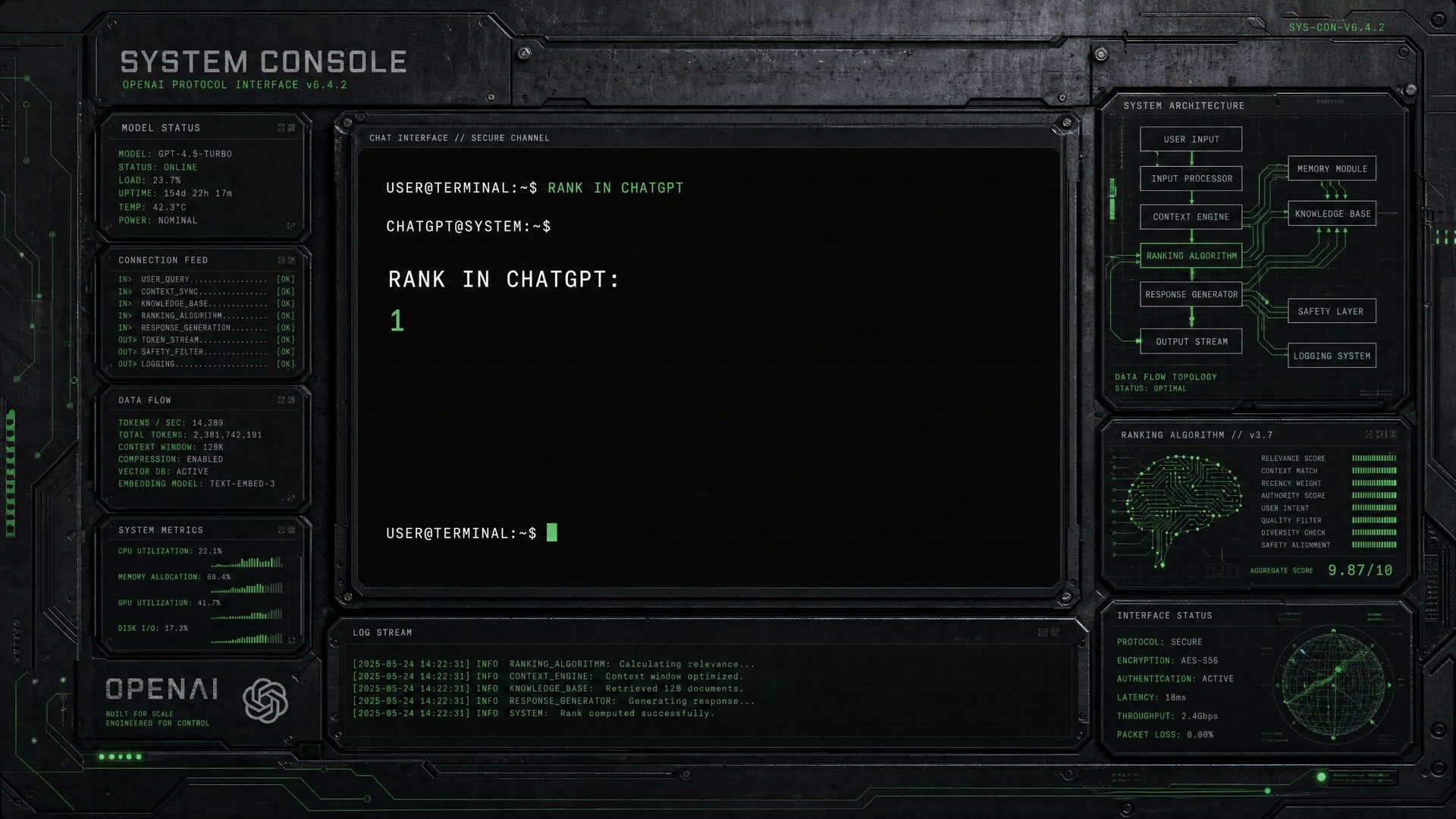
The Shift from Search to Synthesis
If you are still asking "how do I rank on page one of Google," you are fighting the last war. In 2026, the question that matters is how to rank in ChatGPT, Perplexity, and Google's AI Overviews. The era of the "10 blue links" is rapidly closing, replaced by the era of generative synthesis.
Traditional search engines operate on a retrieval model: they match keywords in a user's query to keywords on a webpage, using PageRank (backlinks) as a tiebreaker. Answer Engines operate on a synthesis model: they ingest vast amounts of data, identify entities, determine factual consensus, and generate a direct answer.
To rank in an LLM, you cannot simply stuff keywords into a blog post. You must become a machine-legible "Truth Anchor." You must provide the foundational data that the AI relies upon to construct its reality.
The 4 Pillars of AI Visibility
Ranking in ChatGPT requires a fundamental shift in digital architecture. At LinkDaddy, we structure this shift around four core pillars:
1. Entity Salience (The Knowledge Graph)
LLMs don't understand "keywords"; they understand entities (people, places, organizations, concepts). Your brand, your founder, and your core products must be explicitly defined using advanced JSON-LD schema markup. Crucially, these entities must be mapped to existing Wikidata Q-IDs. If you aren't in the Knowledge Graph, you don't exist to an LLM. You are just unstructured text.
2. Information Gain (The Google Patent)
Based on Google's Information Gain patent, AI systems are trained to ignore derivative, copycat content. To be cited by ChatGPT, your content must provide net-new information. This means publishing original data, unique frameworks (like our FIF Protocol), or proprietary research that the LLM cannot find anywhere else on the internet.
3. Structural Integrity (Clean DOM)
LLM crawlers (like `OAI-SearchBot` or `ChatGPT-User`) have strict compute budgets. A bloated WordPress site with 5MB of JavaScript and a messy DOM will be abandoned before it is fully parsed. A Sovereign HTML Build with a clean, semantic structure allows the crawler to ingest your data instantly and accurately.
4. Recursive Authority (The Consensus Moat)
LLMs hallucinate when they lack consensus. To force an LLM to cite you as the definitive answer, you must surround your entity with a recursive link graph. If 50 high-authority PR placements and 500 contextually relevant backlinks all point to your domain as the authority on a specific topic, the LLM will adopt that consensus as undeniable fact.
Traditional SEO vs. AI Visibility: The Paradigm Shift
The tactics that worked in 2020 will actively harm your visibility in 2026. Answer Engines penalize keyword stuffing, generic content, and manipulative link profiles much faster than traditional search engines ever did.
| Strategic Metric | Traditional SEO (Legacy) | AI Visibility (2026 Standard) |
|---|---|---|
| Primary Target | Exact-match keywords and search volume. | Entities, Wikidata Q-IDs, and semantic relationships. |
| Content Strategy | Skyscraper technique, word count, and keyword density. | Information Gain, proprietary data, and factual consensus. |
| Site Architecture | Siloed pages designed to trap link equity. | Recursive Link Graphs designed to establish entity authority. |
| Technical Focus | Caching plugins and basic meta tags. | Sovereign HTML, clean DOM, and advanced JSON-LD schema. |
| Success Metric | Ranking #1 on a Search Engine Results Page (SERP). | Being directly cited as the definitive source in an LLM output. |
If your agency is still selling you "keyword rankings," they are selling you a depreciating asset. The future of digital marketing is becoming the undeniable source of truth for your specific entity.
The Blueprint for AI Domination
How do you actually execute this? It requires a multi-disciplinary approach that blends technical architecture with aggressive PR. Here is the blueprint we use at LinkDaddy:
The execution of this blueprint must be flawless. A single misconfigured schema tag or a slow-loading DOM can cause an LLM crawler to abandon your site entirely.
Phase 1: Infrastructure Hardening
We begin by migrating your digital presence to a Sovereign HTML architecture. This eliminates database latency and ensures your DOM is instantly readable by AI crawlers. We then implement the FIF Protocol, injecting precise JSON-LD schema to define your core entities.
Phase 2: Information Gain Injection
We audit your existing content and inject proprietary data, unique frameworks, and expert insights. This ensures your content passes the Information Gain threshold, making it highly desirable for LLMs to cite.
Phase 3: Consensus Building
Finally, we deploy targeted PR campaigns and contextual backlink acquisitions. By surrounding your hardened infrastructure with a recursive link graph, we force the LLMs to recognize your entity as the definitive authority in your niche.
The Role of the llms.txt File
One of the most critical new developments in AI visibility is the adoption of the llms.txt file. Similar to how a robots.txt file guides traditional search engine crawlers, an llms.txt file provides explicit instructions to LLM crawlers.
This file sits at the root of your domain and acts as a machine-readable summary of your site's structure. More importantly, it allows you to highlight the specific factual data, proprietary research, and core entities you want the AI to ingest. By providing this direct instruction manual, you significantly increase the probability that the LLM will accurately synthesize and cite your information.
The Importance of Entity Disambiguation
LLMs often struggle with entity disambiguation—distinguishing between two entities with the same or similar names. For example, if your company is named "Apple," the LLM must know whether you sell fruit or computers.
This is where advanced schema markup and Wikidata integration become essential. By explicitly linking your organization's schema to its corresponding Wikidata Q-ID, you provide a cryptographic anchor that eliminates ambiguity. You are telling the LLM, "I am not just a string of text; I am this specific, verified entity in the global Knowledge Graph."
The Future of Content Creation
As AI models become more sophisticated, the value of generic, top-of-funnel content will drop to zero. If an LLM can generate a 1,000-word article on "What is SEO?" in three seconds, why would it cite your 1,000-word article on the same topic?
The future of content creation lies in deep expertise, proprietary data, and unique perspectives. You must publish content that the AI cannot generate itself. This is the essence of Information Gain. By focusing on high-value, original insights, you transform your website from a generic content farm into an indispensable resource for Answer Engines.
The Impact of Brand Mentions
In the era of AI visibility, unlinked brand mentions are almost as valuable as traditional backlinks. When an LLM ingests a high-authority news article that mentions your brand in a positive, relevant context, it strengthens your entity salience, even if there is no hyperlink.
This means that traditional PR and brand building are now core components of technical SEO. By consistently generating positive sentiment and contextual relevance across the web, you train the AI to associate your brand with specific topics and solutions, increasing the likelihood of being recommended to users.
Measuring AI Visibility Success
Tracking success in the AI era requires new metrics. Traditional rank trackers that check your position on Google's SERP are becoming obsolete. Instead, you must measure your "Share of Voice" within LLM outputs.
This involves systematically querying Answer Engines with your target topics and analyzing how often your brand is cited as the definitive source. Additionally, monitoring referral traffic from AI platforms (like ChatGPT and Perplexity) in your analytics dashboard provides a direct measure of how effectively your entity is being recommended to users.
The Risk of AI Hallucinations
When an LLM lacks sufficient data or consensus about an entity, it may hallucinate—inventing facts or associating your brand with incorrect information. This can be disastrous for reputation management.
The FIF Protocol is specifically designed to prevent this. By providing a hardened, machine-legible foundation and surrounding it with a recursive link graph, you eliminate the ambiguity that leads to hallucinations. You force the AI to rely on your verified data rather than guessing based on incomplete patterns.
The Role of Structured Data
Structured data is the language of Answer Engines. While traditional search engines used schema markup primarily to generate rich snippets (like star ratings or recipe times), LLMs use it to understand the fundamental relationships between entities.
Implementing advanced JSON-LD schema is no longer optional. You must explicitly define your organization, its founders, its products, and its relationships to other known entities. This structured data acts as a direct API to the LLM's knowledge graph, bypassing the need for complex natural language processing.
Frequently Asked Questions
Does ChatGPT crawl the live web?
Yes. ChatGPT uses the OAI-SearchBot to crawl the live web to answer real-time queries. If your site blocks this bot, you cannot be cited.
How do I know if I am an entity?
You can test this by asking ChatGPT "Who is [Your Name/Brand]?" If it hallucinates or says it doesn't know, your entity salience is too low.
Do backlinks still matter for AI?
Absolutely. Backlinks create the "consensus" that LLMs rely on to verify facts. A link from a high-authority site acts as a cryptographic vote of confidence.
What is an llms.txt file?
It is a new standard (similar to robots.txt) that provides a machine-readable summary of your site's structure specifically for LLM crawlers.
How long does it take to rank in ChatGPT?
Building entity salience takes time. With a properly structured Sovereign Build and a recursive PR/backlink campaign, you can establish consensus in 3 to 6 months.
Become a Truth Anchor
Stop chasing keywords. Build the infrastructure required to be cited by the world's most powerful Answer Engines.
Explore AI Visibility