WordPress Alternative for Business: The Sovereign HTML Build
Why enterprise businesses are abandoning WordPress for static HTML builds. Learn how to secure your digital infrastructure and own your code.

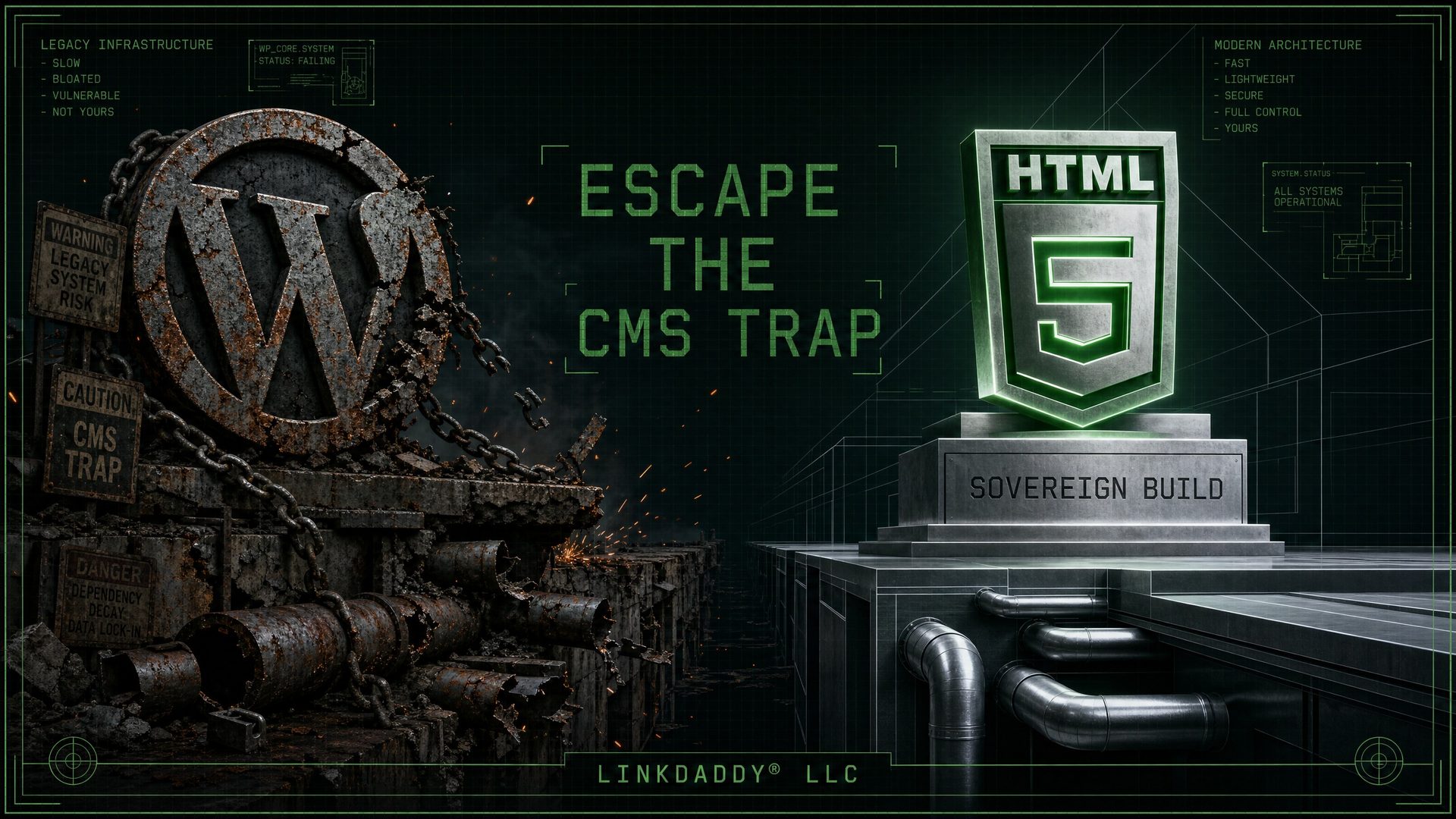
The Hidden Cost of WordPress in 2026
For over a decade, WordPress has been the default choice for business websites. It democratized web publishing, but it also introduced a paradigm of "Structural Decay." In 2026, the landscape has fundamentally changed. The constant need for plugin updates, the vulnerability to zero-day exploits, and the inherent bloat of PHP/MySQL architectures have made WordPress a liability for serious enterprises.
Every time you install a plugin, you are introducing third-party code into your infrastructure. This creates a massive attack surface. Furthermore, the dynamic nature of WordPress—querying a database for every page load—creates latency that harms both user experience and search engine rankings.
A true WordPress alternative for business isn't just another monolithic CMS like Wix or Squarespace. Those platforms simply trade one form of lock-in for another. The real alternative is a fundamental shift in how digital infrastructure is built. It's about moving from rented, fragile platforms to sovereign, hardened assets. This is the core philosophy behind the FIF Protocol (Foundation, Infrastructure, Fortress).
The Blueprint Brutalism Approach: Sovereign HTML
At LinkDaddy, we advocate for "Blueprint Brutalism"—prioritizing patent-compliant structural integrity over aesthetic trends. This means abandoning the bloated database-driven models of the past and embracing Sovereign HTML Builds.
Static HTML builds, powered by modern frameworks like Next.js and deployed on edge networks like Cloudflare Pages, offer unparalleled advantages for enterprise businesses:
- Absolute Security (The Fortress): Because there is no database connected to the live site, and no PHP executing on the server, there is nothing to hack. SQL injection attacks and plugin vulnerabilities are mathematically impossible.
- Sub-500ms Load Times (The Infrastructure): Pages are pre-rendered during the build process and distributed globally across Cloudflare's edge network. When a user requests a page, it is served instantly from the node closest to them.
- True Ownership (The Foundation): You own the code, the assets, and the infrastructure. You are not beholden to a proprietary platform's pricing changes or terms of service. Your digital asset is 100% sovereign.
- AI-Ready Structure: Modern Answer Engines (like ChatGPT and Perplexity) struggle to parse bloated, JavaScript-heavy DOMs. A clean HTML structure, enriched with precise JSON-LD schema markup, ensures your entity is machine-legible.
Decoupling Content from Code: The Headless CMS
The most common objection to abandoning WordPress is: "But how will my marketing team update the blog?" The answer is the Headless CMS architecture.
In a traditional WordPress setup, the backend (where you write content) and the frontend (what the user sees) are tightly coupled. In a Sovereign HTML build, they are decoupled. Your marketing team uses a modern, intuitive interface (like Sanity, Contentful, or even a specialized Git-based CMS) to write content. When they hit "Publish," it triggers a build process that generates a new static HTML file and pushes it to the edge network.
This gives you the best of both worlds: the ease of use of a modern CMS, with the security and performance of a static site.
WordPress vs. Sovereign HTML Builds: The Technical Divide
To understand the magnitude of this shift, we must look at the technical architecture. WordPress was built for an era of dynamic rendering, where servers had to assemble pages on the fly. Sovereign HTML builds are designed for the edge computing era.
| Architectural Feature | Legacy WordPress | Sovereign HTML (Next.js) |
|---|---|---|
| Rendering Method | Server-Side Rendering (SSR) via PHP. Assembles the page upon every user request. | Static Site Generation (SSG). Pages are pre-built into HTML files before deployment. |
| Database Dependency | Requires active MySQL connection. Database queries create bottlenecks. | No live database connection required. Content is baked into the HTML. |
| Security Posture | High risk. Vulnerable to SQL injection, cross-site scripting (XSS), and plugin exploits. | Fortress-level. No database or server-side code to exploit. Mathematically secure. |
| Global Distribution | Requires complex CDN configurations and caching layers to achieve global speed. | Native edge deployment. Files are distributed globally by default (e.g., Cloudflare Pages). |
| AI Machine Legibility | Poor. Bloated DOM structures and excessive JavaScript confuse LLM crawlers. | Excellent. Clean, semantic HTML with integrated JSON-LD schema is easily parsed by AI. |
The data is clear: continuing to build enterprise infrastructure on legacy PHP/MySQL stacks is a strategic error. The future belongs to fast, secure, and machine-legible static builds.
The Migration Process: From Fragile to Sovereign
Migrating from WordPress to a Sovereign HTML build is not a simple "theme change." It is a complete infrastructure overhaul. However, when executed correctly using the FIF Protocol, the transition is seamless and the SEO benefits are immediate.
The migration process must be handled with forensic precision to ensure zero loss of existing organic traffic. Here is the exact methodology we use at LinkDaddy:
Phase 1: Data Extraction & Mapping
We begin with a complete extraction of your existing content, including all text, images, and metadata. We then map your existing URL structure perfectly to the new Next.js routing system. This ensures that every single page maintains its exact URL, preventing any loss of link equity.
Phase 2: Blueprint Brutalism Rebuild
Next, we rebuild the frontend using Blueprint Brutalism principles. We strip away the bloated CSS and JavaScript that WordPress themes rely on, replacing it with lean, utility-first Tailwind CSS. We implement strict JSON-LD schema markup on every page, transforming your content into machine-legible entities.
Phase 3: Edge Deployment
Finally, we deploy the new static build to Cloudflare Pages. The moment the DNS switch occurs, your site goes from a fragile, database-dependent application to a globally distributed, mathematically secure static asset.
The Financial ROI of Sovereign Infrastructure
While the initial investment in a Sovereign HTML build is higher than buying a $50 WordPress theme, the long-term ROI is undeniable. When you eliminate the database, you eliminate the need for expensive managed WordPress hosting, premium security plugins, and constant developer retainers for updates and maintenance.
More importantly, the performance gains directly impact your bottom line. Amazon found that every 100ms of latency cost them 1% in sales. By moving to a sub-500ms edge-deployed architecture, you are actively increasing your conversion rates and securing your position in AI-driven search results.
The End of the Plugin Ecosystem
The WordPress plugin ecosystem is both its greatest strength and its fatal flaw. Every plugin is a potential point of failure. When you rely on 30 different plugins built by 30 different developers, you are essentially outsourcing your infrastructure's security to strangers.
In a Sovereign HTML build, functionality is built natively or integrated via secure APIs. You don't need an SEO plugin because the schema and meta tags are hardcoded into the architecture. You don't need a caching plugin because the site is already static and deployed to the edge. You don't need a security plugin because there is no database to protect.
The Future of Enterprise Web Development
The transition away from monolithic CMS platforms is not a trend; it is a structural necessity. As AI Answer Engines become the primary method of information retrieval, the technical requirements for digital visibility are increasing exponentially.
A Sovereign HTML build is not just a website; it is a hardened node in the Knowledge Graph. It is an asset that you own completely, free from the decay and vulnerabilities of legacy systems. By adopting Blueprint Brutalism, you are future-proofing your business for the next decade of the internet.
The Environmental Impact of Static Builds
An often-overlooked benefit of Sovereign HTML builds is their environmental efficiency. Traditional database-driven websites require constant server processing power to assemble pages on every request. This continuous compute cycle consumes significant energy.
By pre-rendering pages and serving them as static files from edge networks, Sovereign HTML builds drastically reduce server load. The compute cost is paid once during the build process, rather than thousands of times per day. This makes static architecture not only faster and more secure, but also a significantly greener choice for enterprise digital infrastructure.
The True Cost of Ownership
When evaluating CMS platforms, businesses often focus solely on the initial build cost. However, the true cost of ownership for a WordPress site includes premium hosting, paid plugins, security monitoring, and inevitable emergency developer fees when an update breaks the site.
Sovereign HTML builds shift this paradigm. While the initial development requires specialized engineering, the ongoing maintenance costs drop to near zero. Hosting on edge networks like Cloudflare Pages is often free or costs pennies, and the lack of a database means there are no security patches to apply. Over a three-year period, a Sovereign HTML build is significantly more cost-effective than a legacy WordPress setup.
The Transition to Headless Architecture
Moving away from WordPress doesn't mean abandoning content management. The modern approach utilizes a Headless CMS (like Sanity, Contentful, or Strapi). In this architecture, the backend where your team writes content is completely decoupled from the frontend that users see.
When a writer publishes an article in the Headless CMS, it triggers a webhook that rebuilds the static HTML files and deploys them to the edge network. This provides the familiar, user-friendly editing experience of WordPress without any of the security vulnerabilities or performance bottlenecks associated with a coupled architecture.
Frequently Asked Questions
Is it hard to update content without WordPress?
Not at all. We integrate headless CMS solutions (like Sanity or Contentful) that give you a clean, modern interface to update content, while the frontend remains a secure, static build.
Will I lose my SEO rankings if I migrate?
If done correctly, your rankings will likely improve. We map all URLs, implement 301 redirects, and the massive performance boost from static HTML is a strong positive ranking signal.
How much does a Sovereign HTML build cost?
Enterprise builds typically range from $5,000 to $10,000, depending on complexity. This is an investment in permanent infrastructure, eliminating ongoing maintenance and security costs.
Can I host it anywhere?
Yes. Because it's static HTML, you can host it on Cloudflare Pages, Vercel, AWS S3, or any standard web server. You are never locked into a specific provider.
Is it better for AI Answer Engines?
Absolutely. The clean DOM structure, lack of bloat, and integrated schema markup make it significantly easier for LLMs and Answer Engines to parse and cite your content.
Ready to Upgrade Your Infrastructure?
Stop renting fragile platforms. Build a sovereign digital asset that is secure, lightning-fast, and optimized for the AI era.
Explore Sovereign Builds